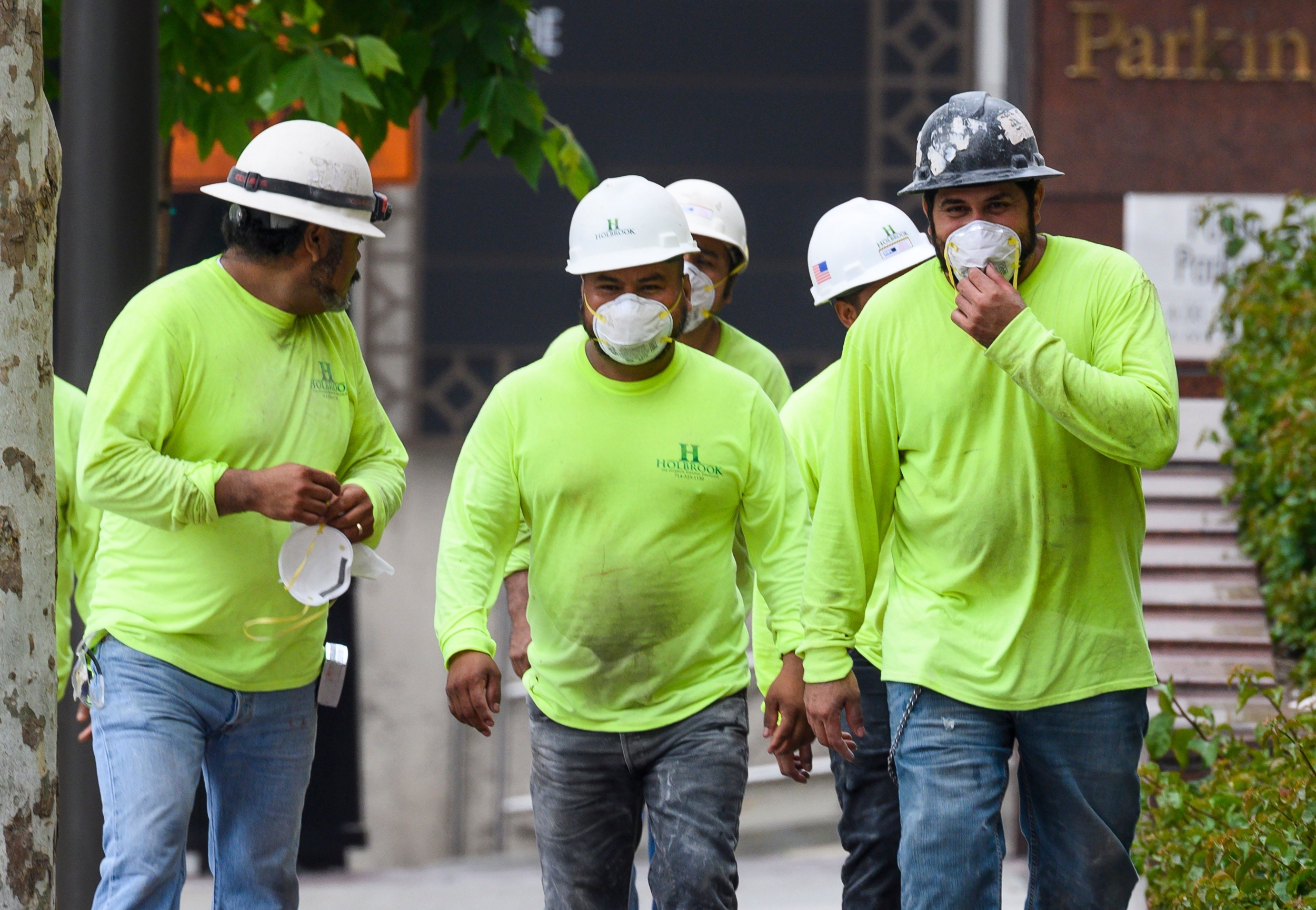
While households in Spokane County are being told to close windows and run filtration, an orchard crew and a framing crew are working outside in the same air. They will absorb a dose of fine particulate matter that no amount of household advice addresses, because the advice assumes you can go indoors.
The difference is not small, and it comes from two multipliers stacked on each other.
The first is time. A resident who makes two short trips outside might accumulate 30 minutes of exposure. A crew works eight to ten hours in it. The second is breathing rate. Physical labor raises minute ventilation substantially, meaning a worker moves several times more air through their lungs per hour than someone at rest. Every additional liter carries the same particle concentration.
Multiply those together and an outdoor worker on a bad smoke day can inhale many times more PM2.5 than a sedentary adult in the same ZIP code. That is why state health officials count outdoor workers among the groups most at risk from smoke, and why Washington wrote a rule specifically for them.
The State Rule Is A Ladder, Not A Switch
Washington is one of only a handful of states with an enforceable wildfire smoke standard. There is no federal OSHA standard for wildfire smoke, which means a crew’s protections depend heavily on which side of a state line they are working on.
Under chapter 296-820 WAC, employer obligations escalate at defined PM2.5 concentrations rather than turning on at a single trigger. The rule tracks the hourly PM2.5 average in micrograms per cubic meter, with corresponding AQI values.
At 20.5 to 35.4 micrograms, roughly AQI 72 to 100, employers must notify workers of conditions, ensure only trained employees work outdoors, consider exposure controls, and are encouraged to provide N95 respirators at no cost on request.
At 35.5 to 250.4 micrograms, roughly AQI 101 to 350, employers must implement exposure controls and make N95 respirators available at no cost for voluntary use. This is the band that covers most smoke days.
At 250.5 to 500.3 micrograms, roughly AQI 351 to 848, employers must distribute N95S directly to each exposed employee rather than simply making a supply available, must encourage their use, and must ensure access to clean air.
From 500.4 micrograms up, employers must implement a complete required-use respiratory protection program including fit testing, medical evaluations, and clean-shaven use, unless exposure totals 15 minutes or less over 24 hours. At 555 micrograms and above, the required respirator must carry an assigned protection factor of 25 or more, which means something more protective than a filtering facepiece.
Oregon operates a separate rule with different trigger points. A contractor whose crews cross the Columbia River cannot run one plan written to one state’s numbers.
Voluntary Use and Required Use Diverge on Fit
This is the part most often misunderstood, and it determines how much a respirator actually accomplishes.
An N95 works by forming a seal against the face so air passes through the filter media rather than around the edges. A fit test verifies that a specific model and size seals on a specific person. Under the rule, a full respiratory protection program with fit testing and medical evaluation applies when PM2.5 reaches 500.4 micrograms or when the employer chooses to require respirator use. Below that, use is voluntary and fit testing is not required.
That means on the vast majority of smoke days, workers are wearing respirators that have never been verified to seal on their faces. The rule acknowledges this and tells workers that even without a fit test, they can take steps to improve the seal.
Those steps are practical. Both straps go around the head, not looped over the ears, with one above and one below the ears. The metal nose clip is molded to the bridge of the nose with two hands rather than pinched with one. A seal check follows: cover the respirator, exhale gently, and feel for air escaping at the edges or fogging on glasses.
Facial hair is the variable nobody enjoys discussing. Stubble and beards break the seal along the jaw and cheeks, and no adjustment fixes it. Where respirator use is required, workers must be clean-shaven. There is one exception worth knowing: loose-fitting powered air-purifying respirators do not depend on a facial seal, which makes them the practical option for workers who cannot or will not shave.
Respirators also increase breathing resistance. Anyone with a heart or lung condition should ask a clinician whether wearing one during physical work is appropriate, since the added effort places its own demand on the cardiovascular system.
Dust Masks and KN95s Are Not Substitutes
Washington’s Labor and Industries guidance is unusually blunt here, and the distinction matters because job sites are full of masks that do nothing for smoke.
Bandanas, scarves, facemasks and t-shirts worn over the nose and mouth “do not provide any protection against wildfire smoke,” according to L&I, and facemasks and dust masks not certified by NIOSH do not adequately protect workers.
KN95s are the trickier case because they look nearly identical to N95s. L&I states that they are not NIOSH-certified and “do not provide protection from wildfire smoke.” A genuine N95 carries NIOSH approval markings printed on the respirator itself. The agency’s position is that a NIOSH-approved N95 is the minimum protection from wildfire smoke.
Questions A Crew Can Ask This Week
Conditions make this immediate. The Spokane Regional Clean Air Agency has an air quality alert in effect with widespread smoke from the local Spokane Complex fires and regional fires, and forecast air quality ranging from Unhealthy to Very Unhealthy as a ridge of high pressure reduces ventilation. Those levels put worksites in the band where N95s must be made available, and potentially into the band where they must be handed to each worker.
Workers in affected areas can ask their employer three specific things without needing to cite the rule by number.
What PM2.5 or AQI figure is the site using, and where does it come from? Employers may use a direct-reading particulate sensor operated under the conditions the rule sets, or rely on published government data. Knowing the source tells a worker whether obligations are being tracked in real time or guessed at.
Are N95S available on site right now, at no cost, and in more than one size? Size availability is the difference between a respirator that seals and one that does not.
Has anyone received wildfire smoke training this season? Training is a prerequisite for outdoor work under the rule at the lowest threshold, and employers must also notify workers each time conditions cross a threshold.
Workers should watch for coughing, chest tightness, wheezing, headache, dizziness, and unusual fatigue, and report symptoms rather than working through them. Difficulty breathing, chest pain, or confusion require immediate medical attention. Workers with asthma or COPD should keep rescue medication on their person rather than in a vehicle. This is general information and is not medical advice.
Concerns about employer non-compliance can be raised with Washington L&I, and the rule bars employers from retaliating against workers who raise safety concerns or report symptoms. Agricultural workers are covered by a parallel rule and can request materials in a language they understand.
MedicalDaily will report changes in state occupational smoke standards and any federal rulemaking on wildfire smoke exposure.
Frequently Asked Questions
Why do outdoor workers face higher exposure? They spend full shifts in smoke and breathe far more air per hour because of physical exertion, so cumulative dose is much higher than for most residents.
When must a Washington employer provide N95s? At PM2.5 of 35.5 micrograms or more, roughly AQI 101, employers must make them available at no cost for voluntary use. At 250.5 micrograms they must be distributed directly to each exposed worker.
Do workers get a fit test? Not for voluntary use. Fit testing, medical evaluation, and clean-shaven use apply when respirator use is required, which begins at 500.4 micrograms or when an employer chooses to require it.
Does a KN95 work for smoke? Washington L&I says no. KN95s are not NIOSH-certified. Look for NIOSH approval markings printed on the respirator.
What about a beard? Facial hair breaks the seal. Loose-fitting powered air-purifying respirators are the exception because they do not depend on a facial seal.
Is there a federal rule? No federal OSHA wildfire smoke standard exists. Protections depend on state rules, and Washington and Oregon use different thresholds.
What symptoms should prompt stopping work? Difficulty breathing, chest pain, dizziness or confusion require immediate medical attention. Persistent cough or wheeze should be reported rather than worked through.