Tag: daily practice

  • The Easiest Way to Deepen Your Yoga Practice? Teach It to a Child.

    The Easiest Way to Deepen Your Yoga Practice? Teach It to a Child.

    “While we try to teach our children all about life, our children teach us what life is all about.”
    Angela Schwindt

    Once I had a baby, I became one of those people with the best intentions for my yoga practice. Even though I knew I wouldn’t be able to walk to the yoga studio for those hour-long classes anymore, I figured I would work it out somehow, that I would find a way to keep my practice alive.

    Like almost every parent I know, I got a shock when the little one finally arrived.

    I tried attending baby yoga classes, but I spent the entire time feeding her. No time for my personal practice there. When she was sleeping, I was too exhausted to leave the couch, let alone give my practice the attention it deserved.

    For a while, I mourned the loss of those studio classes. I missed the guided sequences, the community, the dedicated space just for practice. Once we settled into a little routine, though, I stopped fighting my ache for the yoga studio I’d left behind.

    Discovering a New Way to Practice

    In a way, I stumbled upon this new way of practicing out of necessity. I started meditating with my daughter on my lap. These were short sessions, nothing fancy. Just breath and presence. 

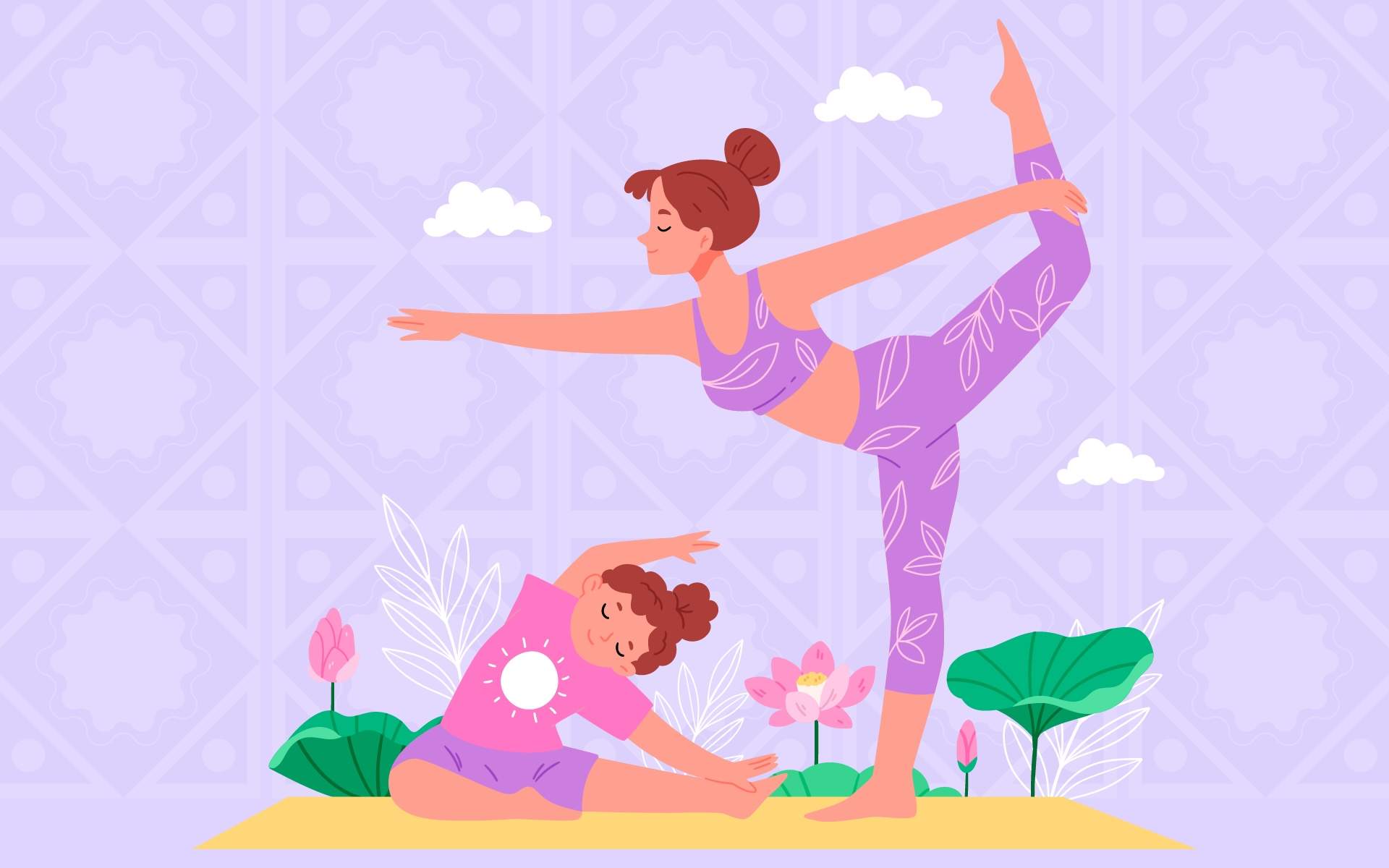
    As she grew older, we began practicing yoga postures together. We would mimic the trees we saw on our walks or the animals we’d watched at the zoo. I would practice mindfulness while swinging her at the playground, bringing awareness to the present moment and practicing gratitude for these precious days.

    Somewhere in all of this, something shifted. My yoga practice became more consistent than it had ever been—not because I was getting to the studio or following hour-long sequences, but because I was already there with my daughter, breathing, moving, and being present together.

    Somewhere in all of this, something shifted. My yoga practice became more consistent than it had ever been—not because I was getting to the studio or following hour-long sequences, but because I was already there with my daughter, breathing, moving, and being present together.

    So, if you’re struggling to maintain your practice, I want to share something that might sound counterintuitive: Practicing and teaching yoga to the children in your life, whether they’re your own kids, nieces and nephews, students, or neighborhood children, might be the key to deepening your own practice.

    Easy Practices to Teach & Try

    Here’s how to turn everyday moments into opportunities for yoga, without adding a single thing to your schedule. I encourage you to try one or more of these, and then adjust them to meet your own needs.

    1. Morning Wake-Up Stretches in Bed

    Before your feet hit the floor, before the day begins, there’s a window for practice. Instead of jumping straight into the morning rush, take two minutes to stretch in bed with your child. Extend your arms overhead. Hug your knees to your chest. Twist gently side to side.

    Make it an invitation rather than an instruction: “Want to stretch with me?” Most kids will naturally join in, and you’re teaching them that movement and breath can be the first choice of the day.

    Make it an invitation rather than an instruction: “Want to stretch with me?” Most kids will naturally join in, especially if it means a few extra minutes of connection before the day demands their attention elsewhere.

    You’re teaching them that movement and breath can be the first choice of the day. You’re giving yourself those moments too. No mat, special outfit, or commute to the studio required.

    Want to make this morning ritual even more powerful? Add an element of gratitude. After a few gentle stretches, share one thing you’re grateful for or one positive thought about the day ahead. “I’m grateful for this cozy bed and this time with you.” 

    Keep it simple. Kids often mirror this practice back, starting their day with appreciation rather than rushing straight into demands and tasks.

    2. Mindful Moments While Waiting

    Waiting is everywhere in life with children. Bus stops. Doctors’ offices. School pick-up lines. Instead of filling these moments with phones or mental to-do lists, turn them into opportunities for presence.

    When my daughter and I wait for the bus together, we’ve started really noticing what’s around us. The snow falling in winter. The leaves changing color in fall. Rain pitter-pattering on the pavement. The birds chirping in the trees nearby.

    “What do you hear right now?” becomes our game. Or “What’s different today than yesterday?”

    This practice of tuning in to the present moment, of noticing what’s actually here rather than rushing ahead to what’s next, is mindfulness in its purest form. The children learn to see the world with fresh eyes, and so do you. 

    3. Deep Breathing Throughout the Day

    You can practice conscious breathing anywhere—before a transition at home, in the car before walking into an appointment, standing in line at the post office, sitting in the doctor’s waiting room, walking from the car to the grocery store entrance.

    Make it simple. Breathe in for four counts, out for four counts. That’s it. No fancy techniques needed. Just intentional breath shared together. The breathing practice I thought I was teaching my daughter? She was internalizing it, making it her own, and reflecting it back to me when I needed it most.

    The more you practice in small moments throughout the day, the more natural it becomes—for both of you.

    A few times when I’ve been in a mental tailspin about something, she’s put her hands on both my shoulders and said, “You’ve got this, Mom. Take a deep breath.”

    The more you practice in small moments throughout the day, the more natural it becomes—for both of you.

    4. The “Drop and Roll” Game

    This is one of my favorite practices for shifting energy quickly! Anytime you need to change the mood, shift your mindset, or get a new perspective, drop into a yoga pose.

    Kids getting restless in the grocery store? “Drop and roll into downward dog right here!” (Yes, right there by the cereal aisle.)

    Feeling stuck on a problem at home? “Let’s do tree pose and see if we can think differently while we balance.”

    Energy getting chaotic before dinner? “Everybody drop into child’s pose for ten breaths.”

    The beauty is that it works anywhere. In the park when emotions are running high. In your living room when everyone needs a reset. Even in the dentist office waiting room when nerves need settling. Any moment can become a practice moment.

    Movement shifts everything. It changes your physical state, which changes your mental state. The children learn this through play, and so do you. Sometimes the fastest way back to center is moving your body in a new way.

    Movement shifts everything. It changes your physical state, which changes your mental state. The children learn this through play, and so do you. Sometimes the fastest way back to center is moving your body in a new way.

    5. Bedtime Meditation 

    If you’ve ever tried to meditate while children are awake and active in your home, you know it’s nearly impossible. But bedtime? That’s your window.

    After stories and tucking in, try a simple body scan or visualization with them. “Close your eyes and imagine you’re a starfish floating in warm water. Feel your arms get heavy. Your legs get soft.”

    By guiding them through relaxation, something happens to your own nervous system. It settles. It softens. Your breath slows. Your shoulders drop. Your mind, which has been running all day, finally gets permission to rest. 

    This thing you’re already doing every night becomes your meditation practice.

    6. Travel Days and Hotel Room Yoga

    Travel with children often means confined spaces and restless energy. As it turns out, these are ideal conditions for yoga. A hotel room becomes a studio. The wait at the airport gate becomes an opportunity for seated twists and neck rolls. The backseat of the car during a rest stop becomes a place for shoulder shrugs and gentle stretches.

    When you reframe “practice” as something that can happen anywhere, you stop waiting for perfect conditions that rarely come.

    Hotel rooms have become unexpected practice spaces for us. We make it playful (animal poses are favorites), but my body still gets the stretch it needs. My breath still deepens. My mind still settles. When you reframe “practice” as something that can happen anywhere, you stop waiting for perfect conditions that rarely come.

    7. Yoga Through Acts of Service

    The mat is just one place yoga lives. It also lives in how we show up in the world and care for others. There are countless opportunities to weave service into your life with children. Volunteering at a food bank. Helping an elderly neighbor with yard work. Making cards for people in nursing homes. Participating in a community clean-up day.

    For ten years, my family has hosted a pajama drive in our town, collecting new pajamas and delivering them to children at a less fortunate city school. This practice of karma yoga—selfless service—has become one of the most meaningful parts of our yoga practice together.

    When children see you modeling a yoga lifestyle that extends beyond poses and breath to include compassion, generosity, and showing up for others, they learn that yoga is a way of being, not just a thing you “do.”

    When children see you modeling a yoga lifestyle that extends beyond poses and breath to include compassion, generosity, and showing up for others, they learn that yoga is a way of being, not just a thing you “do.”

    And you? You’re practicing too. Not on a mat, but in the world, where it matters most.

    The Practice That Was Always There

    What children really need from us isn’t perfection in our practice. They need our presence. And in teaching them simple practices for presence, whether through breath, movement, or mindfulness, you create your own practice without needing to be anywhere other than where you already are.

    My practice now looks different from the way it did before I became a parent. It’s changed and adapted through the years as my daughter has grown. But it’s stayed alive, built into our days together in ways I never could have imagined back when I thought “real” practice only happened in a studio. The practice is in the slow breaths we take together. In the gratitude we share during morning stretches. In our mindful moments waiting for the bus. In the service projects we take on as a family. In the body scans that help her settle into sleep.

    The practice was never supposed to be separate from life. It was always meant to be woven through it. And children, with their natural presence and their ability to find joy in the simplest moments, are some of our best teachers for remembering that.


    Source link

  • Feeling Like a Fraud in Your Own Mindfulness Practice

    Feeling Like a Fraud in Your Own Mindfulness Practice

    Over the years, I’ve worked closely with many meditation practitioners and Buddhist authors, some of whom have been clients, and my own practice has grown alongside those relationships. Being surrounded by people with such depth of experience can be inspiring, but it can also quietly raise the bar for where you think you should be in your ability to navigate life’s difficulties.

    One of the most humbling moments for me came during a trip to the emergency room related to complications from my autoimmune disease. I was in excruciating pain when a close friend, who also has a long meditation practice, asked, half joking, “Are you able to outsmart your pain?”

    We both laughed. The joke landed because another friend of mine, physician and meditation teacher Dr. Christiane Wolf, is a colleague and former client who has written about working with chronic pain through mindfulness in her book Outsmart Your Pain.

    I remember telling her at one point, almost defensively, that I meditate every single day. I had this quiet, competitive edge about it. I did not want to miss a day, even in the hospital. Missing a day felt like a failure.

    I remember telling her at one point, almost defensively, that I meditate every single day. I had this quiet, competitive edge about it. I did not want to miss a day, even in the hospital. Missing a day felt like a failure. In hindsight, that belief feels a little ridiculous, but at the time, it carried real weight.

    At that moment, I was not able to outsmart my pain.

    My response was immediate: “No. I’m not able. I’d like the pain meds.”

    Even as I said it, a small part of me felt inadequate. I was feeling like a fraud. If I had spent years around mindfulness practitioners and teachings about working skillfully with pain, shouldn’t I be better at this?

    Health challenges have given me many moments like that, moments when I questioned my ability to navigate difficulty in the way I believed I should.

    What I didn’t understand at the time was that practice does not always show up in the exact moment of distress. Sometimes it shows up in how we move through the experience afterward.

    Christiane later offered a perspective that shifted something for me.

    “Angela,” she said, “if you’re not meditating when you’re hospitalized, it doesn’t make you a failure. Your practice to date has prepared you to navigate these moments. That’s what the practice is for.”

    “Angela,” she said, “if you’re not meditating when you’re hospitalized, it doesn’t make you a failure. Your practice to date has prepared you to navigate these moments. That’s what the practice is for.”

    It was a simple reminder, but an important one. I realized how quickly I had turned a moment of human vulnerability into a judgment about whether I was doing the practice “well enough.”

    Around the same time, I was helping a menopause telehealth company develop educational content and share mindfulness practices for women navigating perimenopause and menopause. I had no trouble guiding others through meditation or creating resources that helped people access the practice.

    Yet privately, I sometimes struggled to apply the same steadiness to my own life.

    That tension, between helping others access mindfulness and questioning my own ability to embody it, was incredibly revealing. It showed me how quickly self-judgment can creep in, and how easily I hold myself to impossible standards. More importantly, it helped me see where I still have work to do, on the cushion and off.

    Naming the Experience

    As months passed, I became more curious about what might be happening beneath the surface of my experience. I understood the stress and anxiety tied to my health challenges. Those had been part of my life for years. But this felt deeper.

    I began to question my beliefs about how I was supposed to handle difficulty. Clearly, I had internalized an idea of what this should look and feel like, especially for someone with as much mindfulness experience as I had. After more than 15 years working in this space, I had unconsciously decided that I should not be struggling at all.

    I began to question my beliefs about how I was supposed to handle difficulty. Clearly, I had internalized an idea of what this should look and feel like, especially for someone with as much mindfulness experience as I had. After more than 15 years working in this space, I had unconsciously decided that I should not be struggling at all.

    Psychologists have a term for a similar pattern in professional life. The impostor phenomenon, first described by Pauline Clance and Suzanne Imes in 1978, refers to the persistent feeling that we are falling short of a role we are supposed to inhabit, even when there is ample evidence that we belong there.

    While this concept is often discussed in career settings, a similar dynamic can arise in contemplative practice.

    Experienced practitioners are still human. We can be just as overwhelmed by everyday stressors as anyone else, and often, the mind is quick to judge that experience. Mine tends to sound like, If you were truly a mindfulness practitioner, you wouldn’t be feeling this way.

    In those moments, the mind takes a very human experience and reframes it as failure. You’re an impostor.

    Part of what makes this so challenging is that we begin looking for evidence to support that belief, convincing ourselves we are failing at something we were never meant to perfect.

    Part of what makes this so challenging is that we begin looking for evidence to support that belief, convincing ourselves we are failing at something we were never meant to perfect.

    What About Stress?

    To be alive in these times is to experience sustained levels of stress. It does not take much, turning on the news, scrolling through headlines, or navigating daily responsibilities, to feel the weight of political unrest, global uncertainty, financial pressure, social division, and personal strain.

    The nervous system absorbs all of it.

    So how do we regulate ourselves in the midst of this? And what does this have to do with mindfulness impostor syndrome?

    Research in stress physiology shows that when the brain perceives a threat, the body shifts into survival mode. Heart rate increases, breathing changes, and attention narrows toward potential danger.

    In these states of activation, it can feel much harder to access the awareness we have worked so hard to cultivate. This can create a confusing internal signal: If I have these tools, why can’t I use them right now?

    For mindfulness practitioners, this can easily be misinterpreted as a failure of practice.

    But the nervous system is not malfunctioning in these moments. It is responding exactly as it was designed to.

    This misunderstanding is where self-doubt can quietly take hold.

    Clear Seeing

    One of the most widely cited insights from psychiatrist Carl Jung is, “Until you make the unconscious conscious, it will direct your life and you will call it fate.”

    As mindfulness practice deepens, awareness expands. We become more attuned to our internal landscape, our thoughts, emotions, and reactions. As a result, we often begin to notice reactivity more clearly than we did before. What can feel like regression may actually be increased awareness.

    As mindfulness practice deepens, awareness expands. We become more attuned to our internal landscape, our thoughts, emotions, and reactions.

    As a result, we often begin to notice reactivity more clearly than we did before.

    What can feel like regression may actually be increased awareness.

    You might notice yourself getting triggered in situations where, in the past, you would have reacted automatically without even realizing it. Now, there is a pause. A recognition. A moment of seeing what is happening.

    That shift can feel uncomfortable, not because something is going wrong, but because something is being revealed.

    Research on mindfulness suggests that practice strengthens meta-awareness, our ability to observe our own mental and emotional states.

    The reactions themselves may not be new.

    What is new is our ability to see them.

    Expectations and Shame Are Here!

    Most of us carry an internal narrative, one that quietly projects expectations onto our daily lives. In mindfulness practice, this often takes the form of how we think we should feel when we sit.

    Calm. Patient. Equanimous. Grateful.

    We tend to measure success by the presence of these states, while overlooking the full range of human emotion, fear, anger, grief, uncertainty, that are equally part of our experience.

    We tend to measure success by the presence of these states, while overlooking the full range of human emotion, fear, anger, grief, uncertainty, that are equally part of our experience.

    When our lived reality does not match that internal expectation, shame can arise.

    During the months leading up to menopause, I found myself navigating unfamiliar sensations in my body. Many of my tools seemed to disappear. I felt reactive, scared, and uncertain about what was happening.

    And the narrative that followed was harsh:

    You should be handling this better.

    Who are you to guide others if you cannot manage this yourself?

    Instead of simply noticing stress, I added another layer: self- judgment.

    At times, mindfulness concepts themselves can become a form of pressure. Psychotherapist John Welwood described this dynamic as “spiritual bypassing,” using spiritual ideas to avoid or override difficult emotional realities.

    In practice, this can show up in subtle ways, but the result is often the same. We begin to feel guilt or shame about what we are experiencing.

    Dealing with Dysregulation

    Our ideas about mindfulness can sometimes work against us. If we believe the practice should make us calm and less reactive at all times, we set ourselves up for disappointment.

    Mindfulness is not about performing calmness.

    Mindfulness is not about performing calmness.

    As Allen Ginsberg once said, the task is simply to “notice what you notice.”

    When we cultivate awareness, we begin to see our reactions as they arise. Maybe you notice yourself getting triggered in a conversation. Maybe you pause instead of immediately reacting. Maybe you recognize, even afterward, that you were overwhelmed.

    These moments matter.

    Mindfulness meets us exactly where we are.

    It does not require that we arrive in a particular state.

    It asks us to meet whatever state we are in with a bit more awareness, and when possible, a bit more kindness.

    Research on self-compassion suggests that responding to difficult emotions with care rather than criticism supports emotional resilience and regulation.

    When we approach our experience this way, the narrative of failure begins to soften.

    Anyone who has spent time meditating knows that emotions will always arise. What changes is not the presence of emotion, but our relationship to it.

    Instead of asking, Why am I still reacting like this?

    We might ask:

    What is happening in the body right now?

    What is this reaction trying to tell me?

    These questions reopen the possibility of practice, even in the middle of difficulty.

    Anyone who has spent time meditating knows that emotions will always arise. What changes is not the presence of emotion, but our relationship to it.

    Moments of reactivity do not disqualify us from the practice.

    They remind us why we practice. Awareness is not something we perfect. It is something we return to, again and again.


    Source link

  • Flow State: How to Get in the Zone

    Flow State: How to Get in the Zone

    As you have very likely experienced through mindfulness practice, our ordinary state is not one of flow, but of mind wandering—a state in which our attention drifts between the present moment and thoughts about past and future. When we practice presence, we begin regularly shifting our attention back to the present moment whenever our mind wanders.

    Turning attention into engagement is similar. Think of it as “directed presence” or as cultivating presence in the midst of the activities we engage in, whether it’s brainstorming with colleagues, working out, catching up with our partner, or putting our kids to bed. Psychologists have a name for this state of full engagement. They refer to it as “flow.”

    Mihaly Csikszentmihalyi, one of the first psychologists to carry out research on this experience, talks about it in his book Flow: The Psychology of Optimal Experience. He describes flow as “the state in which people are so involved in an activity that nothing else seems to matter; the experience itself is so enjoyable that people will do it even at great cost, for the sheer sake of doing it.”

    Linking Flow State and Mindfulness

    By definition, you can experience presence any time, anywhere: lying on the beach, walking to your car, or sitting in traffic. It can be either passive or active. Flow, on the other hand, is a purely active state that feels almost effortless. According to Csikszentmihalyi, the ideal conditions for flow arise when “both challenges and skills are high and equal to each other.”

    Many top athletes, artists, and intellectuals describe this experience. Greek tennis champion Stefanos Tsitsipas recently described the dramatic shift between when he’s playing normally, versus when he’s playing in a flow state: “It felt like I was in a cage and someone decided to unlock it. I suddenly felt free. Every decision I went for felt right,” he said. “It brings you to another level. You’re not playing with your skill any more, you’re playing with your soul.”

    Flow doesn’t always come naturally. We often have to resist the temptation of short-term pleasure to get there.

    Buster Williams, the legendary jazz bassist, recalls his experience playing with Miles Davis that led to a heightened state of engagement. “With Miles, it would get to the point where we followed the music rather than the music following us. We just followed the music wherever it wanted to go.”

    These descriptions might make flow sound mystical, but you don’t have to be a star tennis player or a legendary jazz bassist to experience a state of full engagement. Whether it’s on a challenging morning run, during an important PTA meeting, or while delivering a presentation at work, flow is something that everyone can access. For example, Csikszentmihalyi’s research found that full-time caregivers were just as likely to experience this state as athletes and musicians. One mother described a state of engagement happening as she worked with her daughter when she was discovering something new. “Her reading is one thing that she’s really into, and we read together. She reads to me, and I read to her, and that’s a time when I sort of lose touch with the rest of the world. I’m totally absorbed in what I am doing.”

    FOMO–The Flow of Missing Out?

    Csikszentmihalyi and fellow researcher Martin Seligman’s research illuminates the connection between flow and well-being. In one study, his team had 250 “high-flow” and 250 “low-flow” teenagers keep a record of their mood at specific times throughout the day. When the team examined the responses, the low-flow teens spent the bulk of their time in a state of disengagement, and were said to either be hanging out at the mall or watching television. The high-flow teens, by contrast, were more likely to spend their time developing hobbies, academic interests, and athletic abilities.

    How did these two groups score on measures of happiness? It turned out that the high-flow group outperformed the low-flow group on every measure of psychological well-being, except one. Seligman writes, “The exception is important: The high-flow kids think their low-flow peers are having more fun, and say they would rather be at the mall doing all those ‘fun’ things or watching television.”

    The only disadvantage of experiencing flow was the feeling of missing out on short-term pleasures. Pleasures that fail to produce long-term happiness. Two helpful conclusions can be drawn from this research.

    First, engagement is associated with an increase in happiness and well-being. The  more we live in the state of flow, the more we grow and  experience meaningful success. However, experiencing  mental health challenges like depression and anxiety may correlate to a reduced ability to access flow. In a 2022 study published in PLOS One, researchers examined 664 musicians (a population with high rates of anxiety) and the factors that made them more or less amenable to a flow state while performing. The researchers found that the more anxiety a musician reported, the less likely they  were to experience flow.

    Secondly, flow doesn’t always come naturally. We often have to resist the temptation of short-term pleasure to get there. When we do, we set the stage for this exquisite experience of total absorption in the task at hand.

    3 Essentials for Flow State

    As Csikszentmihalyi and subsequent flow researchers have identified, three main conditions are needed to experience flow:

    1. A clear and purposeful set of goals for your activity, which helps channel your attention.
    2. A subjective sense of balance between the challenging nature of the activity and your skill-level to navigate it, which leads to feeling absorbed in the activity.
    3. Clear, immediate feedback telling you how well you’re progressing and where you can improve.

    To create these ideal conditions for flow, reserve 10 minutes (or more) each day for engaged and purposeful work. Shut down or silence your phone, close your browser and email, and turn off the TV to eliminate digital distractions. Now, use those 10 minutes to focus on a project, task, or hobby you find difficult yet enjoyable. If you make a mistake or a result isn’t what you intended, instead of criticizing yourself, simply see it as feedback and adjust what you’re doing accordingly.

    You can also try alternating between periods of focused engagement and periods of rest and recovery. Notice when your thinking starts to slow down or when you’re no longer operating at peak levels of focus. Then shift your behavior by taking time to allow your mind to recharge: Walk around, stretch, or take a few deep breaths. Finally, rewire your brain to create this habit by savoring the feeling of giving your mind and body a well earned break. Neuroscientist Judson Brewer says it’s powerful when we start to notice: “What’s it like when I get caught up in thinking, compared to when I’m noticing these body sensations that are trying to tell us to do things, and just being with them? We just have to get out of our own way.”

    How to Get into a Flow State

    For some, flow comes almost naturally. Mozart started playing concerts at age six. Picasso painted his first masterpiece at eight. People like Mozart and Picasso don’t have to consciously train the skill of engagement. This experience of total absorption in the task at hand becomes a way of life early on.

    However, for most of us, discovering how to get into a flow state requires a bit more practice and reflection.

    The first step is to identify activities that offer the potential for flow. Here are three points to help you identify which activities, either at work or at home, may be conducive to a flow state for you: 

    1. Challenge: Remember that flow doesn’t arise when things are easy. It’s actually the opposite. Flow arises when we push our skills and abilities to their very limit. What are the activities that challenge you?
    2. Enthusiasm: Flow and lack of interest don’t go well together. You don’t have to love the activity that you are doing, but it helps if you choose something that brings you at least some level of enjoyment. What are the tasks you enjoy doing?
    3. Skill:  Flow requires a certain level of mastery. A beginner learning to play her first song on the piano is less likely to experience flow than a concert pianist with twenty years of experience. You don’t have to achieve complete mastery, but achieving a high level of skill is essential. What are your most highly developed or natural skills?

    Write your answers to these three questions on a sheet of paper. Then take some time to reflect on the activities in your life that allow you to experience these three qualities.

    Adapted from Start Here: Master the Lifelong Habit of Wellbeing by Eric Langshur and Nate Klemp, PhD.


    Source link

  • How to Feel Present, and Stay Present

    How to Feel Present, and Stay Present

    When your schedule (and your mind) never seem to rest, here are three simple ways to feel more present in everyday life that don’t take much time.

    We’ve all been through a lot—both together and alone—and as the long, warm days of summer turn the corner toward autumn, there’s a little more darkness each night and a cooler nip to the air. It’s like the tilt of the Earth is sending a reminder: that each of us can be the light in the darkness (and that on the other side of that darkness is light).

    Many take this time of year to look back (poring over a summer’s worth of photos, anyone?) or look ahead (rushing into a new term, a new routine, a new vision for what we want to achieve). Here’s an invitation to just be here. Right here, right now, in this moment.

    It’s like the tilt of the Earth is sending a reminder: that each of us can be the light in the darkness (and that on the other side of that darkness is light).

    Some of these moments will bring great peace. Others may leave us in pieces. The more we can bring our focus and presence to these moments, the more skilled we become at kindness, compassion—for ourselves and others—and finding joy, and the more we can surf the changes of life with ease. It all starts with being present, here and now.

    3 Mindful Practices to Feel Present—and Find Your Presence

    1. Bring your whole heart to the moment.

    “Joy has its roots in wholehearted appreciative attention,” writes Willem Kuyken. “As you go about your day, bring your attention to seeing, touching, and listening wholeheartedly—mindful of how you are touching and being touched by the world. Take moments to pause.” There are just two steps in this practice, so you can use it anytime you need it.

    Deepen Your Practice: Unhook from Negativity and Savor Joy

    2.  Find your foundation in the breath.

    When we face stress, it can be tempting to zone out, ruminate on the past, or plan the future. Give yourself—and the mindful kids in your life— the gift of this moment, with a basic breathing practice to anchor you in the simplicity of the present. J.G. Larochette shares a catchy rhyme to help you feel present, calm, and clear all day long: “Repeat to yourself, “I’ve got my feet on the floor, I’ve got my spine in a line, I’ve got my hands in my lap, I’ve got my heart to the sky.”

    Deepen Your practice: A Meditation to Breathe Out Love

    3. Savor what comes.

    It’s all going to come anyway—the good and the bad, the highs and the lows. During his week-long savoring practice, founding editor Barry Boyce writes, “What I was prepared for was taking time to really enjoy things, in the present moment. What I wasn’t prepared for was how much it would challenge underlying attitudes and assumptions.”  It’s an invitation to be with the moments as they come and savor them, no matter their flavor.

    Deepen Your Practice: Gratitude Practice: Savor the Moment by Tapping In to Your Senses

    6 Ways to Enjoy Mindful Walking 

    Research shows that mindful walking in nature offers stress-busting and mood-boosting advantages, plus a welcome chance to stretch our legs. Chris Willard, PhD shares six ways to customize your next mindful stroll.
    Read More 

    • Christopher Willard
    • June 20, 2023


    Source link