Tag: Begins

  • The Walk for Peace: An Invitation to Reimagine Where Peace Begins

    The Walk for Peace: An Invitation to Reimagine Where Peace Begins

    The Walk for Peace has been, in many ways, easy to miss. There are no slogans, no signs held up, no calls to action. 

    Instead, there is just walking. One step, then another. Breath moving in and out. Bodies moving steadily through places designed for speed.

    After 108 days and over 2,300 miles, the Buddhist monks and their beloved dog Aloka have arrived at their destination in Washington, D.C. On February 11, 2026—Day 109—they will host a global loving-kindness meditation at 4:30pm EST. 

    Our current culture is shaped by loud, frantic things: urgency, outrage, and constant stimulation. This long-distance pilgrimage across the United States offers something distinctly countercultural. It is quiet, steady, unassuming, and attentive.

    It’s a (sometimes uncomfortable) reminder that our ideas about peace are often future-oriented and externalized. We imagine a time that’s not-now, where the horrors that plague us are gone, and we can finally feel okay. 

    I live in Minneapolis, right in the city. It is not peaceful here right now. We’re surrounded daily by realities that are destabilizing, uncertain, and frightening. Smack in the middle of that, people here are also quietly nurturing a web of care that extends to neighbors and strangers alike, that is stubbornly insistent on the possibility that we belong to each other.

    What I notice is that we are starved for gentleness in a world that glorifies dominance and control. We ache for compassion in a world that keeps telling us that softness makes us weak and defective.

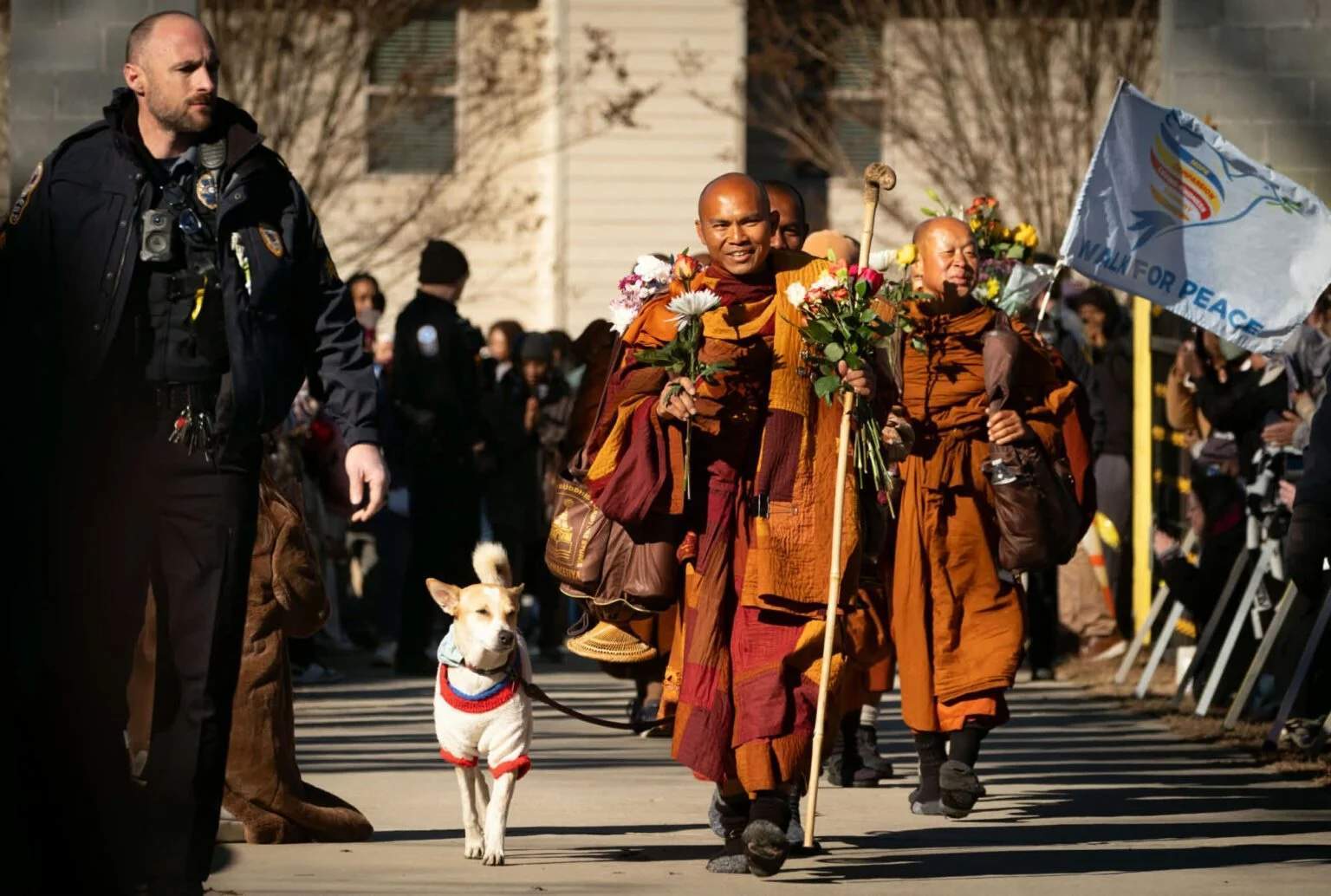
    This past month, I’ve found myself multiple times a week checking in with the Walk for Peace. I watch videos of such tender interactions as people go to watch these monks pass by, sometimes offering flowers or just an encouraging hello. They spontaneously weep, and I do, too. 

    What I notice is that we are starved for gentleness in a world that glorifies dominance and control. We ache for compassion in a world that keeps telling us that softness makes us weak and defective.

    It’s difficult, but also strangely empowering, to sit with the truth that the monks are embodying. Something shifts in me when I begin to think of peace, not as something “out there,” but  as a thing that starts as a tiny kernel in each of us—something we tend like an ember, ignite with our own breath and attention, and then intentionally carry and share with others—moment by moment, step by step.

    What Is the Walk for Peace?

    The Walk for Peace is a long-distance walking journey across the United States, led by a small group of Buddhist monks and supported by volunteers and community members along the way. The route of the walk has stretched over 2,000 miles, beginning in Fort Worth, Texas, and ending in Washington, D.C., crossing ten states along the way.

    While it draws from contemplative Buddhist traditions, the walk itself is not a religious event. It is a lived experiment in mindfulness, compassion, and nonviolence—expressed through the simple act of walking.

    At its core, the walk is a moving mindfulness practice. The participants walk attentively, often in silence, allowing each step to re-anchor them to the present moment. For observers and those who join briefly, the experience can feel unexpectedly grounding. There is nothing to argue with, nothing to agree or disagree with. It’s just people moving through space with care, which is on the surface completely unremarkable—but somehow it feels like the most revolutionary thing.

    By walking attentively through public spaces, the participants model an alternative way of being—one that does not require agreement, belief, or affiliation. With each step, they seem to be simply saying, Notice your breath, notice your pace, notice the people around you. 

    Unlike marches designed to persuade or protest—and of course those also have their place—the Walk for Peace makes no demands. It invites reflection rather than reaction. Many who encounter it describe a sense of calm or curiosity. It’s a noteworthy pause in the usual mental clutter of daily life.

    Rather than addressing specific political outcomes, the walk focuses on something more foundational: how people relate to themselves and one another in everyday life.

    As an intentional mindfulness practice, the walk has highlighted several key principles:

    • Slowing down in a culture that rewards speed
    • Embodied awareness, using movement as an anchor to the present moment in a culture that often uses distraction and numbing
    • Compassion, practiced through respectful presence rather than persuasion
    • Nonviolence, not only as the absence of harm, but as an intentional orientation toward care

    By walking attentively through public spaces, the participants model an alternative way of being—one that does not require agreement, belief, or affiliation. With each step, they seem to be simply saying, Notice your breath, notice your pace, notice the people around you. 

    Peace, in this context, is not an end point, but a capacity that grows with practice.

    The monks have been accompanied by Aloka, a stray who found them in India on another peace pilgrimage. Photo credit: Aloka the Peace Dog

    The First Steps

    Walking has long been associated with reflection and insight. It naturally regulates the nervous system, invites awareness of breath and sensation, and brings attention out of abstraction and into the body. By choosing walking as their medium, the organizers grounded their response in something universally human.

    The Walk for Peace began with a simple question: How do we respond to a world marked by division, stress, and suffering without adding more noise?

    In an informational ecosystem shaped by influencers and social media, we’re accustomed to slogans and sound bites, having people talk at us, trying to shape our thinking and feeling. But these monks aren’t delivering a message to people; they’re living out a practice among them.

    Instead of issuing statements or organizing events, they chose to walk—slowly, visibly, and consistently—through the very communities shaped by the pressures and pains of modern life.

    Portions of the walk, through places like Selma and Montgomery, Alabama, were tracing steps taken by leaders of the Civil Rights movement.

    What is it like for us, generations on, to watch humble people radiating compassion and healing over so much painful ground, to watch them bear witness to realities and tend to wounds that we, collectively, still haven’t fully contended with?

    The steady gaze, pace, and breath of people like the monks remind me [that] no one person is bearing all of this alone. They’re carrying and surrendering, rejoicing and connecting, witnessing and walking, together.

    I drive through Minneapolis and see in real time the trauma of racialized violence: weary but resolute people holding signs on street corners, begging for mercy and humanity; “closed” signs in business windows where workers have been taken; a car parked askew on the road, driver’s side window smashed, door still open. Did someone see it happen at least so that the owner’s loved ones can be notified?

    It is so painful to witness, to look this moment in the eyes. I want to turn away. In my chest, it feels like I’m drowning. But the steady gaze, pace, and breath of people like the monks remind me of two important things.

    First, the longer we resist offering our attention to these unhealed places, the more we will keep living through the reverberating echoes of those same wounds over and over and over again. Different possible futures are only made possible by first giving our loving awareness to what’s happening right now—even (maybe especially) when it surfaces sorrow, hopelessness, or anger that we’re not sure we can handle in the moment.

    Second, no one person is bearing all of this alone. There’s no hero doing all the work. They’re carrying and surrendering, rejoicing and connecting, witnessing and walking, together.

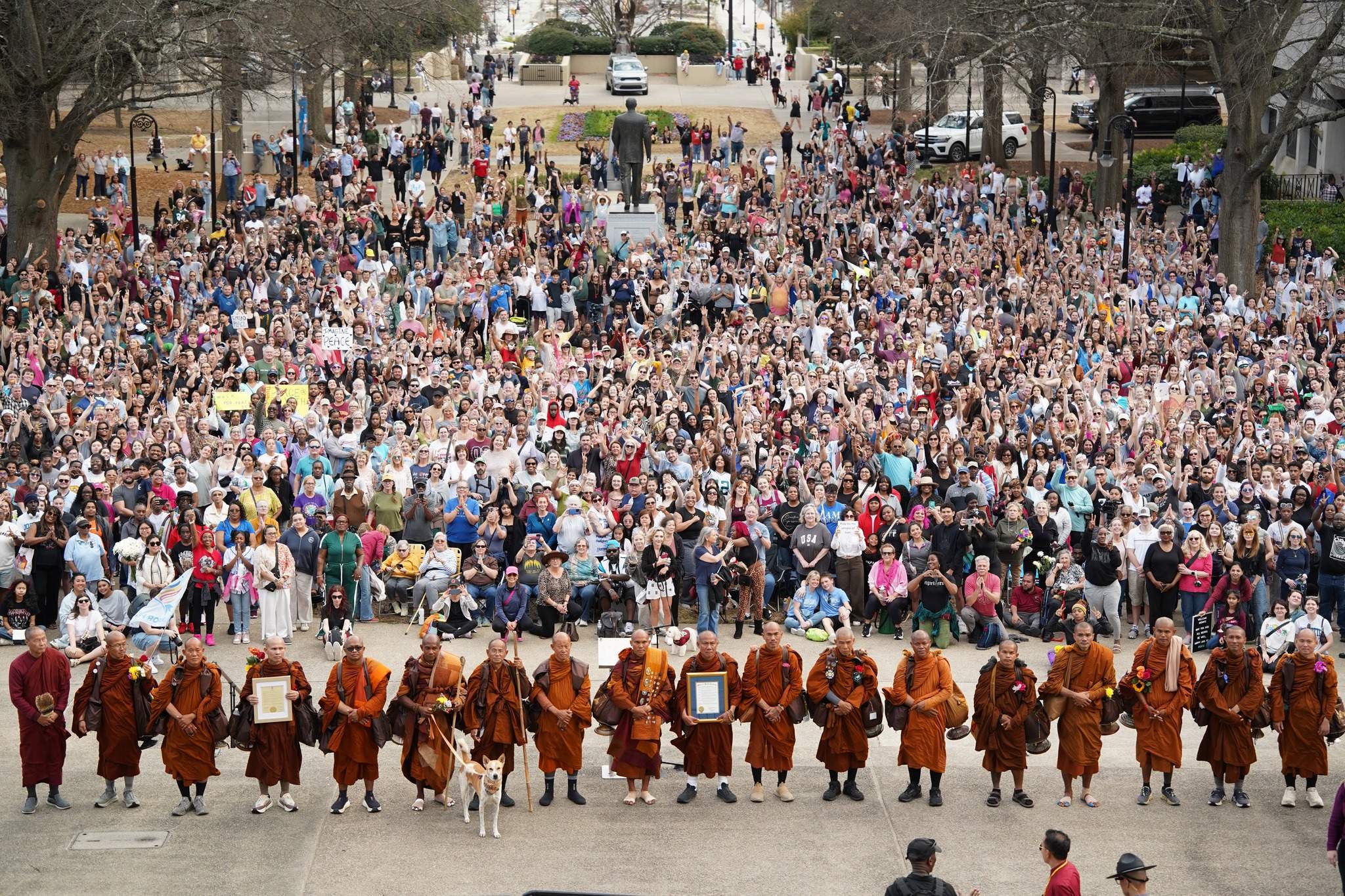
    A large crowd gathers behind monks in orange robes at a Walk for Peace outdoor event, united to reimagine peace together.
    A crowd gathers in South Carolina. Credit: Walk for Peace Facebook page

    How Do People Respond? 

    In many communities, people have gathered along the route—sometimes in the hundreds, sometimes in the thousands—drawn less by promotion than by word of mouth and curiosity. 

    Some offer food or encouragement. Some walk quietly for a stretch, or just stand and watch.

    Online, the walk has attracted millions of followers. Photos and short videos of monks walking through rain, heat, and traffic circulate widely, often accompanied by comments describing a sense of calm or inspiration. 

    Some people express skepticism, questioning whether walking can have any real impact in a world facing complex systemic challenges.  

    This tension is familiar within mindfulness circles, as well. Practices that emphasize inner awareness are sometimes dismissed as passive or insufficient. I understand that skepticism, even as research and lived experience increasingly suggest that attention, regulation, and compassion are not luxuries—they are necessary for wise action.

    Many people who encounter the walk haven’t reported dramatic transformations. They describe something smaller and maybe more sustainable—a softened interaction, an experience of being deeply seen, a reminder to slow down. Again: we so often come looking for drama because we’re conditioned for it—but perhaps what heals us shows up in a thousand quiet, un-social-media-worthy moments.

    Being Peace When Peace Feels Absent

    The Walk for Peace does not claim to solve global problems. It does not promise immediate results. 

    What it offers instead is a living question: What changes when we choose to move through the world with awareness and care?

    Peace is not something we wait for, hoping for external conditions to improve, but something we practice within the conditions we have. 

    Mindfulness practice is rooted in such elemental things—the breath, the body, the next moment. The mind wanders, as it always does, to other things. I think these days of my neighbors, my friends, my worry and anger, the work that needs to be done, what will become of my city, my country. 

    My practice has never been fancy, and even over years now, I have always been more earnest than skilled. Tears sometimes spill over, and my practice is like a cool hand on my forehead, like a reassuring mother, calling me home. 

    The walk has embodied this return home on a collective scale. It suggests that peace is not something we wait for, hoping for external conditions to improve, but something we practice within the conditions we have. 

    I know the walk is coming to its end. In all honesty, I’m going to miss the images and the videos. They have been a kind of nourishment over these long, dark weeks.

    I also know that something real has passed between real people. Maybe for the first time in a long while, we’ve had a glimpse of what happens when we just stop, even for a few moments, and notice one another. On the surface, it’s so tiny it’s almost nothing, just a breath or a blink or a step—but I swear I can sense that spark of compassion leap from one person to another. I’ve felt it here, and I know it matters.


    Source link

  • Trial Of Doctor Accused Of Poisoning 30 Patients Begins In France

    Trial Of Doctor Accused Of Poisoning 30 Patients Begins In France

    A French doctor accused of intentionally poisoning 30 child and adult patients, 12 of whom died, went on trial Monday, saying before the hearing he was not responsible for the “distress” of his alleged victims and their families.

    Frederic Pechier, 53, worked as an anaesthetist at two clinics in the eastern city of Besancon when patients went into cardiac arrest in suspicious circumstances between 2008 to 2017. Twelve could not be resuscitated.

    He is accused of triggering heart attacks in patients so he could show off his resuscitation skills and discredit co-workers.

    Pechier’s youngest alleged victim, a four-year-old identified as Teddy, survived two cardiac arrests during a routine tonsil operation in 2016. The doctor’s oldest alleged victim was 89.

    The trial caps an eight-year investigation that stunned the medical community. Pechier has denied the charges.

    Pechier was greeted on his arrival at the court by several relatives, including one who shouted: “Come on, Fredo.”

    “It’s necessary to lay all the cards on the table,” Pechier told broadcaster RTL earlier Monday, adding that he had “strong arguments” in his defence.

    Asked about the suffering of the families who will attend the trial, set to last until December, Pechier replied: “I understand it completely, but on the other hand, I am not responsible for their distress.”

    Pechier, a father of three, faces life imprisonment if convicted. He is not currently in custody but under judicial supervision, an alternative to pre-trial detention.

    Pechier has not practised medicine since 2017, even though in 2023, he was authorised to work provided he does not come into contact with patients.

    “I’ve been waiting for this for 17 years,” said Amandine Iehlen, whose 53-year-old father died of cardiac arrest during kidney surgery in 2008.

    An autopsy revealed an overdose of lidocaine, a local anaesthetic.

    Prosecutor Etienne Manteaux has said the case is “unprecedented in French legal history”.

    An investigation was opened in 2017 after suspicious cardiac arrests during operations on patients considered low-risk.

    Pechier is suspected of tampering with his colleagues’ paracetamol bags or anaesthesia pouches to create operating room emergencies where he could intervene to show off his resuscitating talents.

    “What he is accused of is poisoning healthy patients in order to harm colleagues with whom he was in conflict,” Manteaux said.

    “Frederic Pechier was the first responder when cardiac arrest occurred,” he added. “He always had a solution.”

    Pechier has blamed “medical errors” by his colleagues for most of the poisonings.

    Some colleagues described Pechier as a “star anaesthetist”, while others said he came across as arrogant and manipulative.

    One co-worker claimed Pechier was “certain he was the best” and liked to “think of himself as Zorro”.

    Over the course of the inquiry, investigators examined more than 70 reports of “serious adverse events”, medical jargon for unexpected complications or deaths among patients.

    The cases of 30 patients who suffered cardiac arrest during surgery at the Saint-Vincent Clinic and the Franche-Comte Polyclinic made it to trial.

    He has criticised the investigation. “What happened to the other cases? They were not retained because Pechier was not involved in them,” he said.

    His defence team will argue for acquittal.

    “It’s very easy to accuse people, it’s harder to prove things,” one of his lawyers, Randall Schwerdorffer, told reporters.

    More than 150 civil parties will be represented at the trial.

    For the first two weeks, the court will examine Pechier’s most recent cases, those that aroused the investigators’ suspicions and led to the anaesthetist being placed under investigation in 2017.

    Afterwards each of the poisonings attributed to the doctor will be examined.

    “It’s going to be a legal marathon, but we’re ready,” Stephane Giuranna, a lawyer for several civil parties, told AFP.

    “All roads lead to Pechier.”


    ‘I just want people to listen for once,’ Frederic Pechier said in an interview


    Source link