Tag: Baby

  • Why Baby Bottle Cleanliness Is More Complex Than It Looks, and How the Momcozy D8 Solves What Manual Cleaning Can’t

    Why Baby Bottle Cleanliness Is More Complex Than It Looks, and How the Momcozy D8 Solves What Manual Cleaning Can’t

    If you have ever rinsed a baby bottle, held it up to the light, and thought, “Looks clean enough,” you are not alone.

    Most parents do exactly that. And honestly, it makes sense. When something looks clear and smells fine, it feels safe.

    But baby bottle hygiene is trickier than it appears.

    Milk fats and proteins can cling to plastic and silicone surfaces, especially inside nipples, valves, straws, and pump connectors. These areas are warm, narrow, and stay damp longer than the bottle itself. Over time, this creates what researchers call hidden residue in baby bottles. This is a thin layer that can support bacterial attachment.

    This is why pediatric cleaning guidelines stress not just washing bottles, but thoroughly cleaning and drying every small feeding component.

    The Real Problem: The Parts You Cannot See

    From a hygiene standpoint, risk is rarely about the bottle wall.

    It is about:

    • Narrow nipple channels
    • Duckbill valves
    • Vent reservoir tubes
    • Internal connectors

    These are perfect environments for biofilm in baby feeding equipment to develop. Manual brushing often cannot reach far inside. Soaking lacks pressure. And dishwashers are designed for plates, not silicone parts with enclosed interiors.

    So parents do what they can: quick scrubs, late-night rinses, crowded drying racks. But many still wonder if the bottles are truly clean.

    A Different Approach: Targeted Deep Cleaning

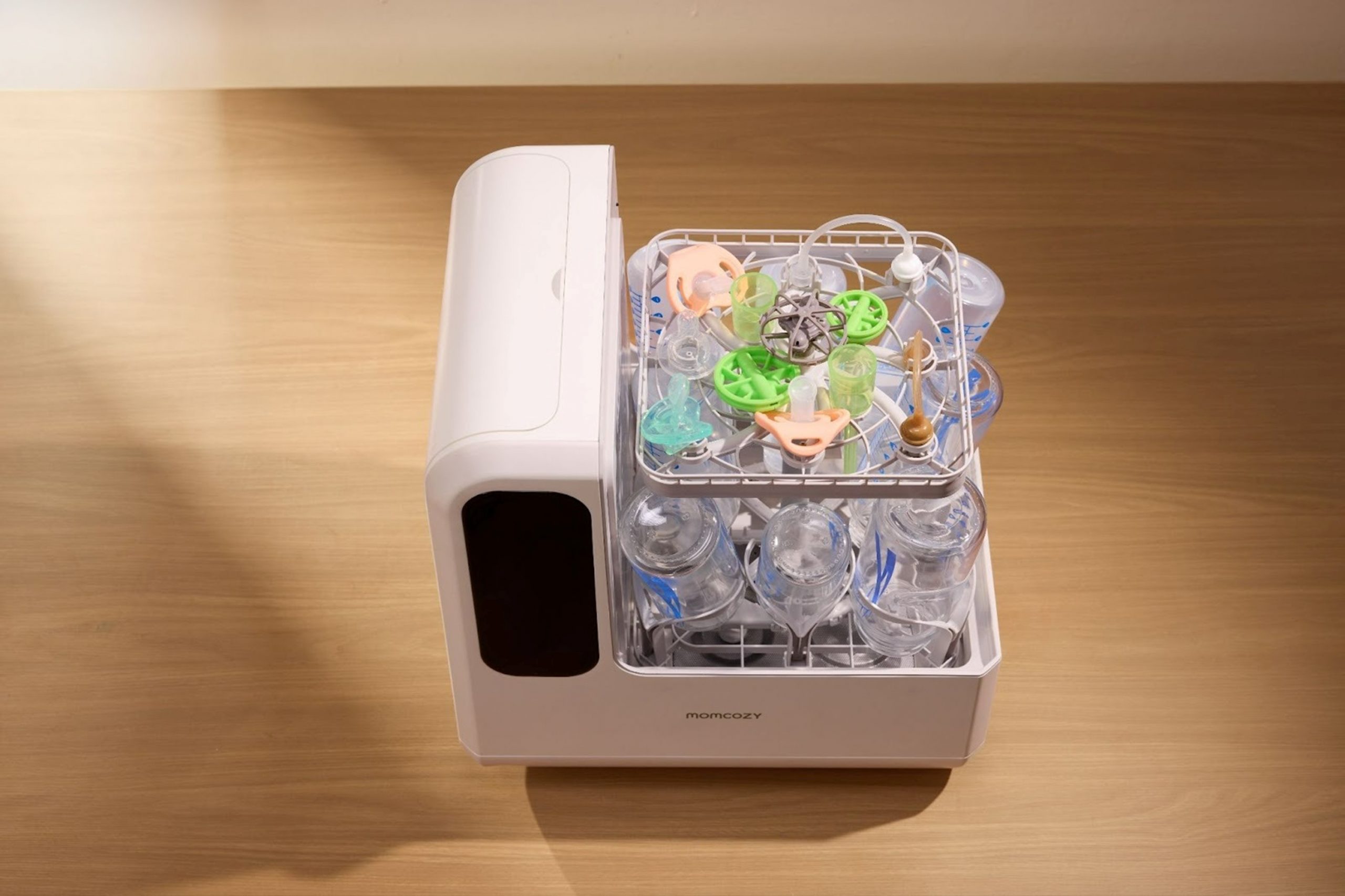
    The Momcozy DeepClean Baby Bottle Washer (D8) was developed to address these specific hygiene challenges, rather than simply automate surface washing.

    Instead of treating all items the same, the system focuses on where residue tends to hide.

    TubeWash™: Cleaning the Inside, Not Just the Outside

    Deep Clean Bottles

    TubeWash™ assigns a dedicated cleaning jet to each small component, like nipples, tubes, duckbill valves, and connectors.

    Anti-flip locks hold lightweight silicone parts, such as—feeding tubes, bottle nipples, valve inserts, and small teething accessories—securely in place during precision cleaning, preventing them from floating or turning away from the water stream. This allows pressurized water to flush internal channels directly, rather than relying on swirling water to reach them by chance.

    From a hygiene perspective, this targeted approach is important because internal surfaces are where milk residue is most likely to persist.

    Pump360™: Reaching Irregular Pump Components

    Pump360 Pump Part Deep Clean

    Breast pump flanges and milk collection cups often have curved or partially enclosed shapes that fixed spray jets cannot fully cover.

    Pump360™ adds a rotating spray attachment that converts fixed jets into multi-angle movement, helping water reach uneven surfaces more consistently. This reduces reliance on hand-brushing complex pump parts, which many parents describe as the most time-consuming step in cleaning routines.

    HydroJet360™: High-Pressure, Multi-Angle Washing

    HydroJet System_Horizontal

    HydroJet360™ uses high-pressure water delivered from multiple angles, supported by a 4-layer spray structure and 44 precision jets, to dislodge residue that low-pressure rinsing may leave behind. Immediately after the wash cycle, the system automatically transitions into 100°C steam sterilization and hot-air drying, helping further reduce moisture and microbial presence on feeding components.

    In addition, the Momcozy DeepClean Baby Bottle Washer D8 has now passed TÜV certification, with independent testing confirming a sterilization rate exceeding 99.99%. According to the available test report, this level of effectiveness supports the system’s role in significantly reducing bacterial presence on baby feeding components when used as directed, while also enabling up to 72 hours of sterile storage to help maintain hygiene between uses.

    While it does not replace medical sterilization guidance, this combined process is designed to significantly lower leftover organic material and provide a strong bacteria-reducing effect, both of which are important factors in limiting bacterial growth in baby feeding equipment.

    A Washer That Cleans Itself

    One often overlooked issue in appliance hygiene is the appliance itself.

    The (D8) includes an automatic self-cleaning system that flushes its internal water lines and chamber after each cycle, helping remove leftover milk residue, mineral buildup such as limescale, and moisture that can support bacterial growth over time.

    By reducing internal buildup inside the chamber and tubing, the system addresses a common limitation seen in traditional bottle washers and humid appliances, where damp, enclosed spaces may otherwise allow contaminants to accumulate.

    Momcozy DeepClean Baby Bottle Washer D8
    Momcozy

    Practical Value for Daily Feeding Routines

    From a hygiene and usability standpoint, the D8’s design follows a clear structure:

    1. Capacity First

    It functions as an 8-bottle capacity bottle washer, allowing parents to clean a full day’s feeding equipment in one cycle.

    Less backlog. Fewer rushed cleanings.

    2. Deep Cleaning of Critical Parts

    TubeWash™, Pump360™, and HydroJet360™ focus on nipples, valves, tubing, and connectors—the areas most vulnerable to biofilm in baby feeding equipment.

    This is the core hygiene benefit.

    3. Long-Term Internal Safety

    The self-cleaning system helps maintain internal cleanliness, reducing maintenance burden and uncertainty over time.

    Together, these layers support consistent baby bottle hygiene rather than occasional “best-effort” cleaning.

    A Note on Safety and Medical Guidance

    While deep-clean technology can support safer feeding routines, this product does not replace medical sterilization guidance or pediatric advice. Parents should continue to follow recommendations provided by their child’s healthcare provider, particularly for premature infants or babies with specific medical needs.

    Hygiene, with a Human Side

    For many families, the benefit is not only technical.

    Less time scrubbing narrow parts at the sink means fewer late-night cleaning sessions. One-button operation simplifies nighttime routines. And greater confidence in bottle cleanliness can reduce the quiet anxiety many parents carry around feeding safety.

    In that sense, systems like the Momcozy DeepClean Baby Bottle Washer (D8) are not just about convenience. They reflect a shift toward treating feeding hygiene as a structured, reliable process—not a guessing game performed multiple times a day.

    In Summary

    Baby bottle hygiene involves more than visible cleanliness. Milk residue, moisture, and tight spaces make feeding equipment prone to biofilm formation—something manual washing often struggles to prevent.

    By combining targeted jets, rotating spray coverage, pressure-based cleaning, large capacity, and internal self-maintenance, the Momcozy DeepClean Baby Bottle Washer (D8) offers a structured approach to deep cleaning for baby bottles that goes beyond convenience.

    For families balancing safety, time, and fatigue, that structure can make daily feeding routines feel a little more manageable and a lot more certain.


    Source link

  • Brain-Dead Georgia Woman Kept Alive Due to Pregnancy Delivers Baby Weighing Less Than 2 Pounds Via C-Section

    Brain-Dead Georgia Woman Kept Alive Due to Pregnancy Delivers Baby Weighing Less Than 2 Pounds Via C-Section

    A Georgia woman who was put on life support after being declared brain dead in February at eight weeks pregnant has given birth to a baby boy.

    Adriana Smith’s son, named Chance, was delivered by emergency cesarean section early Friday morning, June 13, at just under 26 weeks gestation, Smith’s family told 11 Alive. Weighing approximately 1 pound 13 ounces, he is currently in the neonatal intensive care unit (NICU).

    “He’s expected to be OK,” Smith’s mother, April Newkirk said. “He’s just fighting.”

    Smith, 31, was declared brain dead on February 19 after suffering a medical emergency linked to blood clots in her brain. Her case garnered national attention as her family said they were told Georgia’s abortion law—House Bill 481, also known as the LIFE Act—required that she be kept on life support to allow the pregnancy to continue, even though she was legally dead.

    State officials later said the law does not mandate life support in such cases, but the lack of clarity contributed to confusion and distress for Smith’s family.

    Newkirk said doctors had hoped to deliver the baby closer to 32 weeks but were forced to act early. The family now prepares to say goodbye to Smith, who will be removed from life support on Tuesday.

    “She was a ray of light,” Newkirk said. “I shouldn’t be burying my daughter. My daughter should be burying me.”

    Smith leaves behind two sons: newborn Chance and a 7-year-old. The family has launched a fundraiser to help cover mounting hospital costs and provide long-term support for the children.

    Newkirk is calling for greater clarity and compassion in laws impacting medical decision-making, particularly in complex cases like her daughter’s. “I’m not saying we would have chosen to terminate her pregnancy,” she said. “But we should have had a choice.”

    Originally published on Latin Times

    Source link

  • Pregnant Woman And Baby Saved After Doctors Identify Her Bad Cough, Breathlessness Was Rare Tumor In Chest

    Pregnant Woman And Baby Saved After Doctors Identify Her Bad Cough, Breathlessness Was Rare Tumor In Chest

    MaKenna Lauterbach from Illinois was 36 weeks pregnant when she received the shocking diagnosis of a large tumor in her chest, revealing the real cause of the persistent cough and breathlessness during her pregnancy. The 26-year-old, who was diagnosed with stage 3 melanoma, is now stable and recovering, along with her healthy baby, thanks to the timely intervention and coordinated efforts of a dedicated team of doctors.

    When Lauterbach experienced a bad cough while she was expecting, she knew something was wrong. Simple tasks, like walking to the barn to feed her horses, left her unusually winded, as if she had just run two miles. However, doctors were initially hesitant to perform chest scans due to concerns about radiation exposure.

    When Lauterbach was almost due, the cough worsened to the extent that she started throwing up and had to be hospitalized for shortness of breath. The scans then revealed a grapefruit-sized tumor in her chest, blocking the artery to her right lung.

    By the time Lauterbach received the diagnosis, she was in respiratory distress, the tumor obstructing her airway, putting both her life and her baby’s at risk.

    After being airlifted to the intensive care unit at Northwestern Memorial Hospital in Chicago, her condition worsened, she went into labor, her blood pressure spiked, and the baby began showing signs of distress during contractions.

    “Lauterbach was in real trouble, and we had to act quickly – this wasn’t something that could wait for Monday morning. When you’re pregnant with a baby that’s nearly full-term, your lungs already aren’t functioning at full capacity, and when you add a huge tumor on top of it, you run the risk of having respiratory collapse and cardiac arrest,” said Dr. Lynn Yee, maternal-fetal medicine specialist at Northwestern Medicine in a news release.

    Doctors quickly prepared Lauterbach for extracorporeal life support (ECMO) and performed an emergency C-section, successfully delivering a healthy baby boy.

    “Because of the tumor, the delivery happened so quickly. I was grieving the birth plan I had spent months preparing for, while also dealing with the news of my unexpected diagnosis,” Lauterbach said.

    While her newborn remained in the hospital’s neonatal intensive care unit, doctors performed an advanced bronchoscopy on Lauterbach. The procedure revealed that her tumor was stage 3 melanoma, prompting the medical team to immediately begin developing a treatment plan.

    “Lauterbach’s diagnosis was difficult to make because we weren’t sure if the melanoma started in the chest or somewhere else, and there isn’t much literature or published cases on how to best treat tumors like these, so we had to rely on the expertise that we’ve developed here at Northwestern Medicine,” said Dr. Kalvin Lung, a thoracic surgeon with the Northwestern Medicine Canning Thoracic Institute.

    The medical team decided on surgery to remove the tumor. Before the procedure, Lauterbach was given three cycles of immunotherapy which helped shrink the tumor from 13 centimeters to nine centimeters.

    “We think at some point, Lauterbach had a melanoma on her skin and her own immune system took care of it, but not before a cell or two may have escaped and eventually started growing inside her body,” explained Dr. Sunandana Chandra, medical oncologist with the Robert H. Lurie Comprehensive Cancer Center of Northwestern University at Northwestern Memorial Hospital.

    During the surgery, doctors had to remove her right lung parts of the main pulmonary artery, and lymph nodes. “The tumor was sitting on top of Lauterbach’s heart and extended into the right lung, impacting all three lobes and the entire main trunk of the pulmonary artery, which is why we had to remove the right lung,” said Dr. Lung who conducted the surgery along with Dr. Chris Mehta, a cardiac surgeon with the Northwestern Medicine Bluhm Cardiovascular Institute.

    “It’s extremely rare to see this type of tumor invading into the major blood vessels of the heart. We may see something like this once every few years,” Dr. Mehta added.

    Lauterbach’s latest scans show no evidence of metastatic melanoma, and while her cancer remains stable with no new tumors, she will continue immunotherapy treatments for the next year.

    Source link

  • Just 80 Minutes Of Weekly Exercise Reduces Baby Blues, Postpartum Depression Symptoms: Says Study

    Just 80 Minutes Of Weekly Exercise Reduces Baby Blues, Postpartum Depression Symptoms: Says Study

    For new moms who are looking for an all-natural way to ease their baby blues or depression, here’s some good news: a brisk walk or yoga might be just what you need to relieve symptoms. Researchers have found that mothers who engage in exercise programs with at least 80 minutes of moderate activity each week experience significant reductions in the severity of baby blues and postpartum depression.

    Postpartum depression is a serious mental health condition impacting over 10% of women in the first year after childbirth. Hormonal shifts, genetic predisposition, and environmental factors can trigger it. In contrast, the ‘baby blues’ is a milder, temporary form of depression that usually fades within a few weeks as hormone levels stabilize.

    Researchers behind the latest study investigated the benefits of exercise on maternal mental health by evaluating 35 studies involving 4072 participants from 14 countries. Participants exercised at different frequencies, from 1 to 5 days a week, with sessions lasting between 15 and 90 minutes. Activities included aerobic exercise, strength training, stretching, yoga, and combinations of these forms.

    “Pooled data analysis of the study results showed that compared with no exercise, exercise-only interventions were associated with less severe symptoms of depression and anxiety after giving birth and an almost halving in the odds (45%) of developing major postpartum depression,” the news release stated.

    Although with an increase in exercise volume, there were greater reductions in depression symptoms, researchers noted significant positive effects, even with a minimum threshold of 80 minutes per week of moderate activities spread across at least four days. Moderate activities included brisk walking, water aerobics, stationary cycling, and resistance training with bands, weights, or body weight.

    Based on these findings, researchers recommend starting postpartum exercise within the first three months after childbirth for improved mental health.

    “The findings of this review show the efficacy of exercise in improving mental health outcomes for postpartum individuals. Given the comparable effectiveness we observed of postpartum exercise in reducing depressive symptom severity to conventional treatments, exercise could provide mothers with relatively safe, accessible and inexpensive alternatives to address mental health conditions,” the researchers wrote in the study published in the British Journal of Sports Medicine.

    “Additionally, using exercise to improve postpartum mental health could reduce current concerns with conventional treatment options, such as the largely unknown long-term effects of antidepressant use during lactation on the child or prohibitive costs of regular psychosocial therapy visits,” they added.

    Source link