
Tag: Angioplasty

  • The Risks vs. Benefits of Angioplasty and Heart Stents 

    The Risks vs. Benefits of Angioplasty and Heart Stents 

    What do physicians and stent companies have to say for themselves, given that they promote expensive, risky procedures with no benefit?

    “Percutaneous coronary intervention (PCI)”—angioplasty and stent placement—“continues to be frequently performed for patients with stable [non-emergency] coronary artery disease, despite clear evidence that it provides minimal benefit…” The procedure does not prevent heart attacks or death for patients with stable angina pectoris, for example, yet nearly nine out of ten patients mistakenly believed that it would reduce their chances of having a heart attack. “At the same time, the cardiologists who referred them for PCI and those who performed the procedure generally did not believe that PCI reduces the risk for MI [myocardial infarction or heart attack] in stable angina.” Then why on earth were they doing it?

    “Focus groups of cardiologists have documented a chasm between knowledge and behavior; while aware of the results of clinical trials”—that is, evidence to the contrary—“they recommend and perform PCI because they believe that it helps in some ill-defined way.” “Physicians tended to justify a non-evidence-based approach (‘I know the data shows there is no benefit, but’) by focusing on the ease of PCI and belief that an open artery was better”—even if it doesn’t actually affect outcomes—“while minimizing the risks of PCI.” The procedure only kills 1 in 150, so some are blaming the patients for not listening, but maybe the physicians are the ones who are ignoring the evidence.

    Or “physicians may have too poor a grasp of relevant statistics to adequately inform their patients.” Regardless, what we have is “a failure to communicate.” So, tools have been developed. For example, a sample informed consent document lays out the potential benefits and risks, even laying out how many procedures doctors have performed and any out-of-pocket costs. As you can see below and at 1:58 in my video Angioplasty Heart Stent Risks vs. Benefits, there are a lot of blanks to be filled in. What are some concrete numbers? 

    As you can see below and at 2:20 in my video, the Mayo Clinic came up with some prototype decision-making tools. In terms of benefits, “Will having a stent placed in my heart prevent heart attacks or death? No. Stents will not lower the risk of heart attack or death,” but a week later those getting stents report they feel better—though, a year later, even the symptomatic-relief benefit appears to disappear. Nevertheless, there appeared to be a benefit of temporary relief of chest pain. What about the risks? 

    As shown below and at 2:53 in my video, during the stent procedure, out of a hundred people, two will have bleeding or damage to a blood vessel and one will have a more serious complication, such as heart attack, stroke, or death. Then, during the first year after the stent placement, three will have a bleeding event because of the blood thinners that must be taken because of the foreign material in the heart, but that doesn’t always work, so two people will have their stent clog off, leading to a heart attack. 

    What does the world’s number one stent manufacturer have to say for itself? It acknowledges that the evidence shows that stents don’t make people live longer, but the manufacturer thinks living longer is overrated. If we only cared about living longer, in medicine, “entire disciplines would dwindle or even disappear, such as dermatology, ophthalmology, orthopedic surgery, and dentistry.” So why go to the dentist? Of course, the difference is that 80 percent of people don’t believe that getting a cavity filled is going to save their life, like they mistakenly do for stents, as shown here and at 3:18 in my video, and there isn’t a one in a hundred chance you won’t make it out of the dentist chair. 

    The stent companies actively misinform with ads making heart-warming copy. “Open your heart and your life.” “When you open up your heart, you open up your life. LIFE WIDE OPEN.” “Freedom begins here.” Their TV ads mention a few side effects, but it turns out they missed a few. More importantly, they’re giving the false impression that stents are more than just expensive, risky band-aids for temporary symptom relief. But what’s wrong with symptom relief? Even if the benefits are only symptomatic and won’t last long, what’s the problem if people think that outweighs the risk?

    What if I told you that even the symptom relief might just be an elaborate placebo effect, and you could get the same relief from a fake surgery, so there really aren’t any benefits at all? We’ll see what the science says—next. 


    Source link

  • Why Aren’t Angioplasty Heart Stents More Effective? 

    Why Aren’t Angioplasty Heart Stents More Effective? 

    Most heart attacks are caused by nonobstructive plaques that infiltrate the entire coronary artery tree. There is no such thing as “1-vessel disease,” “2-vessel disease,” or “left main disease.” Atherosclerotic plaque is continuous throughout the coronary arteries of heart attack victims. 

    In angioplasty, a tiny balloon is inserted into a narrowed coronary artery that feeds the heart to force it to open wider to improve blood flow. It wasn’t put to the test in a randomized controlled trial until 1992. It not only failed to prevent heart attacks, but it also failed to show any survival benefit. However, the researchers only followed patients for six months and included people with relatively minor diseases who might not have been sick enough to benefit from the procedure. Enter the MASS trial. Researchers enrolled those with severe blockage high up in their left anterior descending coronary artery—the widow-maker or widower-maker (since coronary artery disease is also the number one killer of women)—and followed them for years. The findings? There was no difference in subsequent mortality or heart attack rates. There were only about 200 patients in that trial, though. Maybe the benefit was so subtle that a greater number of patients were needed to tease out the effect. Enter the RITA-2 study, which randomized more than a thousand patients. Researchers did indeed find a clear difference in the risk of future death and heart attack, but it was in the wrong direction. The angioplasty group suffered twice the risk compared to those randomized to forgo surgery, as shown below and at 1:18 in my video Why Angioplasty Heart Stents Don’t Work Better

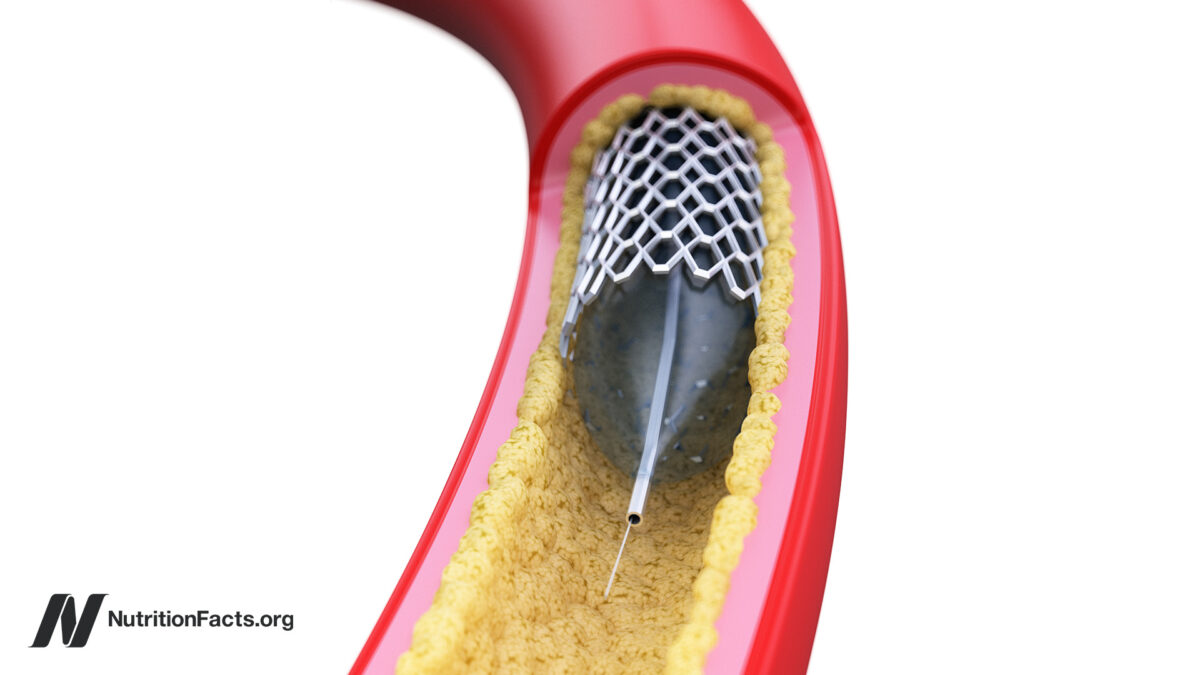
    This was all before stents came into vogue, though. Instead of just ballooning up the artery, how about permanently inserting a stent, a metal mesh tube, to prop open the artery, as you can see here and at 1:33 in my video? Surely, that’s got to help. 

    Enter the MASS-II trial, which, again, saw no benefit after one year—but no benefit was seen after five years or even ten years. Then came the Courage Trial, which randomized thousands of patients, and it, too, fell flat on its face. 

    Those mostly used bare metal stents, though, not the newer “drug-eluting” ones that release drugs slowly. And what about high-risk groups, such as those diagnosed with diabetes and other more serious diseases, or those who have 100 percent blocked arteries days after having a heart attack? In meta-analysis after meta-analysis, looking at five trials with 5,000 patients, there was no reduction in death, heart attack, or even angina pain. In ten trials with more than 6,000 patients, there was no benefit for survival, heart attacks, or pain relief. Now, we’re up to more than a dozen major trials and nothing: no benefit from angioplasty and stents. “Furthermore, multiple analyses have failed to identify a single high-risk subset that benefits…” How is that possible? You’re physically opening up blood flow.

    The reason it doesn’t work is that the majority of heart attacks in real life are caused by narrowings less than 70 percent—“i.e., most likely non-flow-limiting lesions”—so the plaques in our arteries that kill us tend not to be the ones that are restricting blood flow. Shown below and at 3:21 in my video are two atherosclerotic plaques. The one circled in green and labeled “Flow-limiting lesion” is squeezing off the blood flow so much that it can be seen on an angiogram and doctors can go after it with a stent. 

    Problem solved and life saved, right? No, because it was the invisible one (circled in yellow below) that wasn’t even impeding blood flow that was going to kill us all along, as you can see here and at 3:27.

    Indeed, most heart attacks are caused by nonobstructive plaques that don’t even cut blood flow by 50 percent, as seen below and at 3:40 in my video

    There’s a misconception, a “clogged pipe analogy of stable coronary heart disease [that] has been particularly difficult to dislodge,” in which cholesterol plaques slowly and inexorably encroach on blood flow, eventually cutting it off completely and triggering a heart attack. In reality, “coronary artery disease…is an inflammatory disease in which cholesterol from the blood is deposited in artery walls, causing an inflammatory reaction, like a pimple. When those pimples pop, they cause the blood in the arteries to clot at the site…Before rupture, these plaques often do not limit flow and may be invisible to angiography and stress tests. They are, therefore, not amenable to percutaneous coronary intervention (PCI),” that is, to angioplasty and stents. Old plaques are like “scarred old pimples.”

    The tightest blockages are made up of mostly calcified and dense fibrous scar tissue. They can still rupture and kill us, but there are so many more of the smaller lesions brewing, which are hidden from view. The way we visualize coronary arteries is with an angiogram. X-rays are taken after a black-looking dye is injected into the arteries, so we can only see plaques that encroach on the blood flow. That’s why we get these kinds of tip-of-the-iceberg illustrations, the point of which “is to emphasize that most of the atherosclerotic plaque in the coronary arteries is not seen well by angiography,” as you can see below and at 4:49 in my video. To really understand what’s going on in people’s arteries, we must turn to autopsy. William Clifford Roberts is probably the most pre-eminent cardiovascular pathologist in the world. What did he learn after studying coronary arteries for 50 years? After examining nearly 2,000 bodies, he learned that atherosclerosis is a systemic disease. 

    “In patients with fatal coronary artery disease…the quantity of plaque is enormous. There is not just 1 plaque here, another plaque there, with normal lumen [clean arteries] between plaques. Plaques are continuous! Not a single 5-mm segment is devoid of plaque” in the entire coronary artery tree. So, says Dr. Roberts: “Isolated coronary disease is a myth. There are no such things as ‘1-vessel disease,’ and ‘2-vessel disease.’ Plaque is in all of the epicardial coronary arteries if it is in 1 of them.”

    Four main coronary arteries feed the heart—the right coronary artery, the left main coronary artery, the circumflex coronary artery, and the left anterior descending coronary artery, as seen here and at 6:00 in my video

    If we add up their lengths, that’s about 11 inches (28 cm) of coronary arteries, which, for examination, can be cut into about 50 quarter-inch (5-mm) slices. Shown below and at 6:17 in my video is what is seen: Plaque isn’t gunking up one or two slivers but throughout all the coronary arteries. If we look at more than a thousand of these slices from dozens of patients who died of heart attacks, “not a single segment was devoid of plaque.” So, it’s no wonder that stenting open in just one area has no impact on heart attacks or death.


    Source link

  • The Effectiveness of Angioplasty and Heart Stent Procedures 

    The Effectiveness of Angioplasty and Heart Stent Procedures 

    There are demonstrably no benefits to the hundreds of thousands of angioplasty and stent procedures performed outside of an emergency setting. They don’t prevent heart attacks, enable you to live longer, or even help with symptoms any more than placebo (sham) surgery. 

    Large national cardiology conferences may attract the majority of cardiologists across an entire country, convening them in one place. “While at the large cardiology conventions…[it’s been] joked that the convention center would be the safest place in the world to have a heart attack.” And, indeed, that’s when the American Heart Association president had his, within hours of his presidential address. With so many of the nation’s top cardiologists at a conference, that may be a bad time to go into cardiac arrest anywhere else, though. You don’t know until you put it to the test.

    To much surprise, researchers found substantially lower mortality among those going into cardiac failure or cardiac arrest during the dates of national cardiology meetings. Why is the death rate lower when most of the cardiologists are away? “‘One explanation for these findings is that the intensity of care provided during meeting dates is lower and that…the harms of this care may unexpectedly outweigh the benefits,’ the researchers wrote.” Their results “echo paradoxical findings documented during a labor strike by Israeli physicians in 2000, in which hundreds of thousands of outpatient visits and elective surgical procedures were canceled, but by many accounts mortality rates dramatically fell during the year.” And it wasn’t just one strike. “Doctors’ strikes and mortality” have been looked at multiple times. In all reported cases, “mortality either stayed the same or decreased during, and in some cases, after the strike.” In four of the seven cases, “mortality dropped as a result of the strike, and three observed no significant change in mortality during the strike or in the period following the strike.”

    The fact is that many current medical practices have been found to offer no benefit and present potential harm. Even physicians themselves estimate that about one-fifth of medical care is unnecessary. A national summit was convened by The Joint Commission, which accredits hospitals, and the American Medical Association to identify areas of overuse, “described as the provision of treatments that provide zero or negligible benefit to patients, potentially exposing them to the risk of harm.” Five practices were called out, including prescribing antibiotics for viral upper respiratory tract infections and spending a billion dollars prescribing drugs that don’t work (and, if anything, make things worse). Another overused practice identified was elective percutaneous coronary intervention (PCI)—in other words, angioplasty and stents, as I discuss in my video Do Angioplasty Heart Stent Procedures Work?.

    To get everyone on the same page before we dive in: Coronary artery disease, the number one killer of men and women, involves blockages in the blood vessels that supply the heart muscle itself. Low blood flow can lead to angina, a type of chest pain, or, if it’s severe enough, to a heart attack. Plant-based diets and lifestyle programs have been shown to reverse these blockages by treating the cause of why our arteries are clogging up in the first place, but for those unable or unwilling to change their diets, there are drugs that can help, as well as more invasive treatments, such as open-heart surgery to try to bypass the blockage or percutaneous coronary intervention, when “doctors insert small balloons or tunnels (stents) attached to flexible tubes (catheters) into the large blood vessels in the patient’s groin and thread them up into the heart. The stent and catheter are passed through the blocked vessels, a process that opens up the vessels.” In this way, they can get inside the blocked vessels and try to open them up and keep them propped open. During a heart attack, this can be lifesaving, but hundreds of thousands of these procedures are performed every year for stable angina, meaning on a non-emergency basis. It can relieve angina symptoms “but it does not reduce a person’s chances of having or dying of a heart attack.”

    However, not everyone knows that. “Some patients and doctors mistakenly believe that PCI does more than just reduce symptoms.” That’s one of the reasons I’ve created a video series on the topic. As Harvard put it: “Stents are for pain, not protection.” Then, unbelievably, it was discovered that stents may not even help with pain, as revealed in a double-blind, randomized controlled trial. People can be blinded to the active treatment in a drug trial by receiving a placebo sugar pill, but wouldn’t they notice if they had surgery? If a doctor cut into their groin? Not if they had sham surgery—placebo surgery. “In both groups, doctors threaded a catheter through the groin or wrist of the patient…up to the blocked artery. Once the catheter reached the blockage, the doctor inserted a stent or, if the patient was getting the sham procedure, simply pulled the catheter out.” The results? Those who underwent the fake surgery did just as well as those who had the regular PCI surgery.

    There are no benefits to angioplasty and stents outside of an emergency setting. They don’t prevent heart attacks, they don’t enable us to live longer, and they don’t even help with symptoms. “Since the procedure carries some risks, including death, stents should be used only for people who are having heart attacks…” How are hundreds of thousands of people getting these operations for nothing? How do the doctors justify it? Is it just greed? How do they get patients to consent to it? Do they just not tell them the truth? And why doesn’t it work? After all, a blocked artery is being opened up. There are just so many questions, which we’ll start addressing next.


    Source link