Tag: 3MCPD

  • 3-MCPD in Refined Cooking Oils

    3-MCPD in Refined Cooking Oils

    There is another reason to avoid palm oil and question the authenticity of extra-virgin olive oil.

    The most commonly used vegetable oil in the world today is palm oil. Pick up any package of processed food in a box, bag, bottle, or jar, and the odds are it will have palm oil. Palm oil not only contains the primary cholesterol-raising saturated fat found mostly in meat and dairy, but concerns have been raised about its safety, given the finding that it may contain a potentially toxic chemical contaminant known as 3-monochloropropane-1,2-diol, otherwise known as 3-MCPD, which is formed during the heat treatment involved in the refining of vegetable oils. So, these contaminants end up being “widespread in refined vegetable oils and fats and have been detected in vegetable fat-containing products, including infant formulas.”

    Although 3-MCPD has been found in all refined vegetable oils, some are worse than others. The lowest levels of the toxic contaminants were found in canola oil, and the highest levels were in palm oil. Based on the available data, this may result in “a significant amount of human exposure,” especially when used to deep-fry salty foods, like french fries. In fact, just five fries could blow through the tolerable daily intake set by the European Food Safety Authority. If you only eat such foods once in a while, it shouldn’t be a problem, but if you’re eating fries every day or so, this could definitely be a health concern.

    Because the daily upper limit is based on body weight, particularly high exposure values were calculated for infants who were on formula rather than breast milk, since formula is made from refined oils, which—according to the European Food Safety Authority—may present a health risk. Estimated U.S. infant exposures may be three to four times worse.

    If infants don’t get breast milk, “there is basically no alternative to industrially produced infant formula.” As such, the vegetable oil industry needs to find a way to reduce the levels of these contaminants. This is yet another reason that breastfeeding is best whenever possible.

    What can adults do to avoid exposure? Since these chemicals are created in the refining process of oils, what about sticking to unrefined oils? Refined oils have up to 32 times the 3-MCPD compared to their unrefined counterparts, but there is an exception: toasted sesame oil. Sesame oil is unrefined; manufacturers just squeeze the sesame seeds. But, because they are squeezing toasted sesame seeds, the 3-MCPD may have come pre-formed.

    Virgin oils are, by definition, unrefined. They haven’t been deodorized, the process by which most of the 3-MCPD is formed. In fact, that’s how you can discriminate between the various processing grades of olive oil. If your so-called extra virgin olive oil contains MCPD, then it must have been diluted with some refined olive oil. The ease of adulterating extra virgin olive oil, the difficulty of detection, the economic drivers, and the lack of control measures all contribute to extra virgin olive oil’s susceptibility to fraud. How widespread a problem is it?

    Researchers tested 88 bottles labeled as extra virgin olive oil and found that only 33 were found to be authentic. Does it help to stick to the top-selling imported brands of extra virgin olive oil? In that case, 73% of those samples failed. Only about one in four appeared to be genuine, and not a single brand had even half its samples pass the test, as you can see here and at 3:32 in my video 3-MCPD in Refined Cooking Oils.

    Doctor’s Note

    If you missed the previous post where I introduced 3-MCPD, see The Side Effects of 3-MCPD in Bragg’s Liquid Aminos.

    There is no substitute for human breast milk. We understand this may not be possible for adoptive families or those who use surrogates, though. In those cases, look for a nearby milk bank.


    Source link

  • Chlorohydrin 3-MCPD in Bragg’s Liquid Aminos

    Chlorohydrin 3-MCPD in Bragg’s Liquid Aminos

    Chlorohydrin contaminates hydrolyzed vegetable protein products and refined oils.

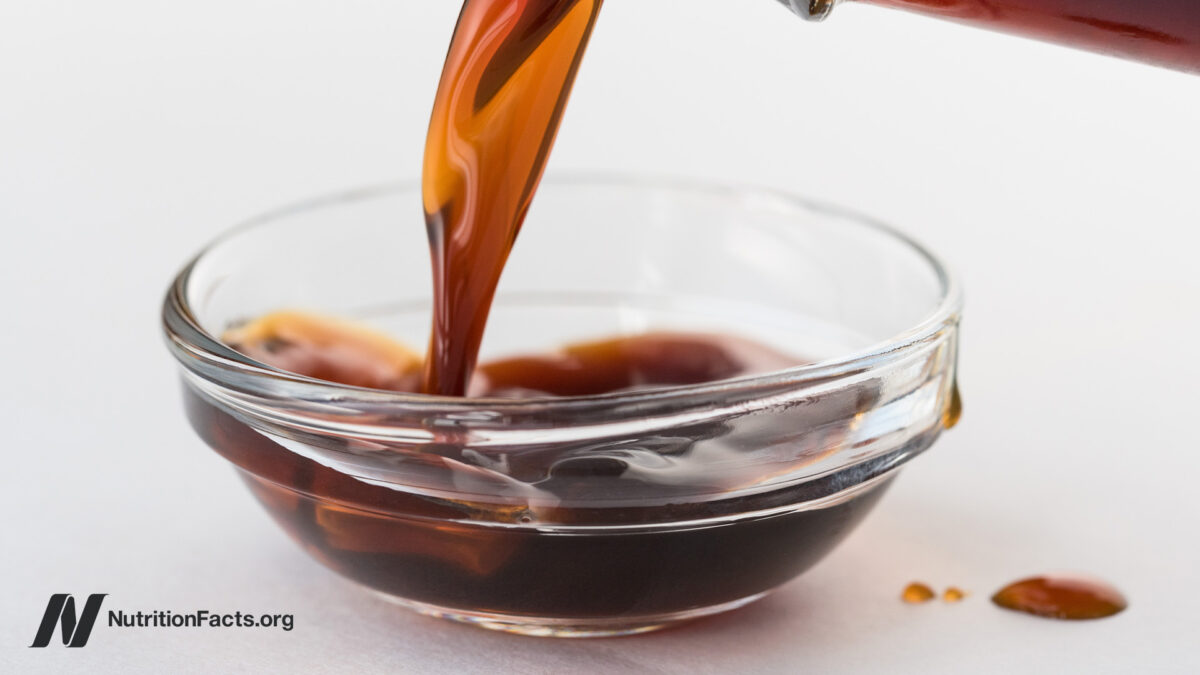
    In 1978, chlorohydrins were found in protein hydrolysates. What does that mean? Proteins can be broken down into amino acids using a chemical process called hydrolysis, and free amino acids (like glutamate) can have taste-enhancing qualities. That’s how inexpensive soy sauce and seasonings like Bragg’s Liquid Aminos are made. This process requires high heat, high pressure, and hydrochloric acid to break apart the protein. The problem is that when any residual fat is exposed to these conditions, it can form toxic compounds called chlorohydrins, which are toxic at least to mice and rats.

    Chlorohydrins like 3-MCPD are considered “a worldwide problem of food chemistry,” but no long-term clinical studies on people have been reported to date. The concern is about the detrimental effects on the kidneys and fertility. In fact, there was a time 3-MCPD was considered as a potential male contraceptive because it could so affect sperm production, but research funding was withdrawn after “unacceptable side effects [were] observed in primates.” Researchers found flaccid testes in rats, which is what they were going for, but it caused neurological scars in monkeys.

    What do you do when there are no studies in humans? How do you set some kind of safety factor? It isn’t easy, but you can take the lowest observed adverse effect level (LOAEL) in animal studies, which, in this case, was kidney damage, add in some kind of fudge factor, and then arrive at an estimated tolerable daily intake (TDI). For 3-MCPD, this means that high-level consumers of soy sauce may exceed the limit. This was based on extraordinarily high contamination levels, though. Since that study, Europe introduced a regulatory limit of 20 parts per billion (ppb) of 3-MCPD in hydrolyzed vegetable protein products like liquid aminos and soy sauce. The U.S. standards are much laxer, though, setting a “guidance level” of up to 50 times more, 1,000 parts per billion.

    I called Bragg’s to see where it fell, and the good news is that it is doing an independent, third-party analysis of its liquid aminos for 3-MCPD. The bad news is that, despite my pleas that it be fully transparent, Bragg’s wouldn’t let me share the results with you. I have seen them, though, but I’m only allowed to confirm they comfortably meet the U.S. standards but fail to meet the European standards.

    This is just the start of the 3-MCPD story, though. A study in Italy tested individuals’ urine for 3-MCPD or its metabolites, and 100% of the people turned up positive, confirming that it’s “a widespread food contaminant.” But 100% of people aren’t consuming soy sauce or liquid aminos every day. Remember, the chemical results from a reaction with residual vegetable oil. When vegetable oil itself is refined, when it’s deodorized and bleached, those conditions also lead to the formation of 3-MCPD.

    Indeed, we’ve known for years that various foods are contaminated. In what kinds of foods have these kinds of chemicals been detected? Well, if they’re in oils and fats, then they’re in greasy foods made from them: margarine, baked goods, pastries, deep-fried foods, fatty snacks like potato and corn chips, as well as infant formula.

    The U.S. Food and Drug Administration’s limit for soy sauce is 1,000 ppb, but donuts can have more than 1,200 ppb, salami more than 1,500 ppb, ham nearly 3,000 ppb, and French fries in excess of 6,000 ppb, as seen here and at 4:03 in my video The Side Effects of 3-MCPD in Bragg’s Liquid Aminos.

    Most of us don’t have to worry about this problem, unless we’re consumers of fried food. Someone weighing about 150 pounds, for example, who eats 116 grams of donuts, would exceed the European Food Safety Authority’s TDI, even if those donuts were the person’s only source of exposure. That’s about two donuts, but the same limit-blowing amount of 3-MCPD could be found in only five French fries.

    Doctor’s Note

    Believe me, I pleaded with the Bragg’s folks over and over. It’s curious to me that Bragg’s allowed me to talk about where its level of 3-MCPD fell compared to the standards but not say the number itself. At least it’s doing third-party testing.

    Learn more about this topic in my video 3-MCPD in Refined Cooking Oils.

    You can also check out Friday Favorites: The Side Effects of 3-MCPD in Bragg’s Liquid Aminos and Refined Cooking Oils.


    Source link