


The subscription company points to studies led by a Harvard- and Yale-trained University of Arizona scientist to support an unusual claim that the energy of a space can be changed remotely. Here is a fair look at the evidence and its limits.
The idea that your surroundings affect how you feel isn’t controversial. Decades of environmental psychology link light, noise, air quality, and clutter to mood, sleep, and the ability to concentrate, and the wellness industry, worth an estimated 1.8 trillion dollars by McKinsey’s count, has built a healthy market on that premise, from circadian lighting to air purifiers. Focused Life Force Energy takes the same starting point and pushes it somewhere far less conventional. The company says it can raise the energy of a home, office, or phone remotely, with nothing to install, and it points to its own research to back up the claim. For a health-minded reader, the interesting question isn’t whether the pitch sounds unusual. It’s what the evidence actually shows.
Focused Life Force Energy, based in Nelson, British Columbia, sells what it calls a high-consciousness energy field, delivered to a specific location and maintained remotely around the clock. Subscribers can try it through a fifteen-day free trial with no credit card, and the company reports more than 13,000 subscribers across 86 countries. What sets FLFE apart from most wellness subscriptions isn’t the pitch, which is easy to wave off, but the fact that it has put real effort into measuring real outcomes and following the data wherever it leads.
The Research the Company Points To
According to the company, the field can be activated around a home, business, phone, water bottle, or other designated object without any physical equipment at the location. FLFE says this occurs through a process it describes as quantum association, sometimes explained using the phenomenon of quantum entanglement, where a proprietary system of coils, plates, and sacred geometry located elsewhere establishes what it calls a high-consciousness field around the chosen target
In practical terms, subscribers simply register an address or object through an online portal, and the field is said to remain active continuously until they turn it off.
Much of FLFE‘s research has been guided by Gary E. Schwartz, a professor at the University of Arizona with training from Harvard and Yale and Director of the Laboratory for Advances in Consciousness and Health, where he has spent years studying consciousness and energy. In a forty-five-day study the company conducted, participants reported meaningful changes: roughly a 49 percent drop in the intensity of stress symptoms, a 47 percent improvement in sleep, and gains of around 46 to 49 percent in mood and mental clarity. Separate testing using EEG, carried out with the Institute of Noetic Sciences, recorded increases in alpha brainwave activity, the pattern tied to calm, focused states. The company has even run agricultural trials, reporting roughly 167 percent stronger root growth in one plant study and higher crop yields in fields it says were exposed to the field. Across its human data, FLFE says more than 80 percent of users report noticing some benefit.
Schwartz’s own interpretation, according to the company, is that the results go beyond what a placebo would explain. That’s a strong claim, and it’s worth holding both halves of it at once: the measurements are real and were taken seriously, and the conclusion drawn from them is one researcher’s reading of the company’s own data.
Schwartz has argued that the findings go beyond what would typically be expected from placebo because the reported effects extend beyond self-reported human experiences to include EEG measurements, plant-growth studies, and other experiments where participant expectation cannot account for the results.
Where the Evidence Runs Out
Here is the part a careful reader needs. None of this research has been published in peer-reviewed journals, the venue where independent scientists pressure-test methods and results before a field accepts them
The studies were funded and conducted in connection with the company whose product they evaluate, a common limitation for early-stage research, and one that means the results haven’t yet had the independent replication that would let them stand on their own.
FLFE says its system creates a high-consciousness field through a process it calls quantum association, drawing on concepts such as quantum entanglement. Its proposed mechanism, and the broader consciousness framework informed by psychiatrist David Hawkins’ Map of Consciousness, falls outside current mainstream scientific consensus.
It’s also fair to mark where FLFE brushes up against science that is well established. The human body generates measurable electrical activity and associated electromagnetic fields, and researchers have long studied how biological systems interact with their physical environments.
The human body generates measurable electrical activity and associated electromagnetic fields, a well-established feature of biology.
Researchers have also shown for decades that the environments we inhabit influence health and well-being. Natural daylight helps regulate circadian rhythms and sleep, while views of nature have been associated with faster recovery among hospital patients and lower stress levels
The evidence there is concrete: hospital patients in rooms with natural light and views tend to recover faster, and daylight exposure measurably improves sleep. FLFE extends those accepted ideas past the point instruments can currently follow. Whether that extension is visionary or a leap too far is exactly what the evidence can’t yet settle.
How People End Up Deciding for Themselves
Because the science is frontier, the company has built its model around personal experience rather than argument.
The free trial is the centerpiece of that approach. Many people don’t notice FLFE when it’s working. They notice it when it stops. When the free trial ends, and the contrast between ‘regular life’ and life imbued with a high-consciousness field becomes apparent, the difference may become more noticeable.
Whether that traces to the high-consciousness field, to the small rituals that form around it, or to expectation is the open question, and it’s one each user effectively runs on themselves.
Whether those experiences arise from the high-consciousness field itself, the routines and habits that develop around it, the power of expectation, or some combination of these remains an open question—one each user ultimately explores for themselves.
The Company Behind It
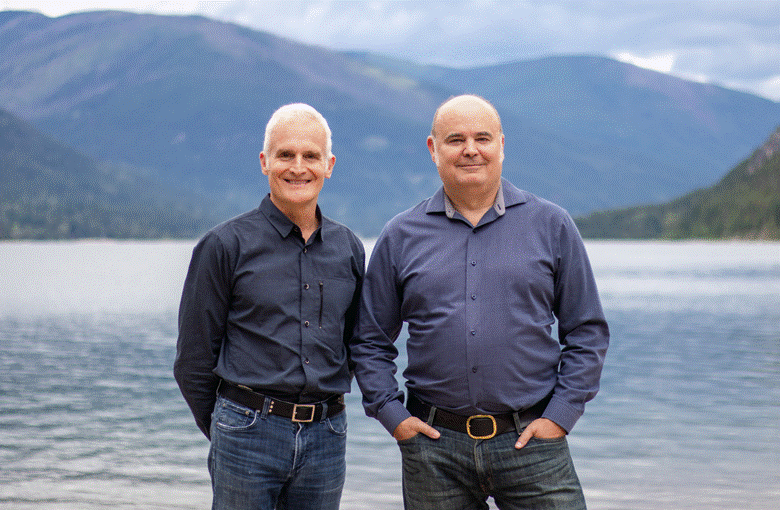
Long before it was a company, Focused Life-Force Energy was a question two men kept asking separately: whether the energy in the spaces we live in shapes us more than we realize. Jeffrey Stegman was asking it through business. Clayten Stedmann was asking it through spiritual coaching. In Nelson, British Columbia, Canada, they found out they were asking the same thing.
What started as a shared experiment turned into FLFE, and eventually into an international subscription business. The founders describe it as mission-led as much as commercial: they say a meaningful share of the field FLFE generates is directed toward what they call consciousness-raising service work around the world, funded by paying subscribers. It’s an unusual structure, and it may explain something real about the loyalty the company inspires — subscribers often describe a renewal less like a purchase and more like a contribution to something larger.
For a health-minded reader, the honest bottom line is neither dismissal nor endorsement. FLFE has done more to measure its effects than most wellness brands bother to, and a credentialed scientist stands behind the work. It also hasn’t cleared the bar of independent, peer-reviewed replication that separates a promising signal from an established fact. That leaves it where a lot of emerging wellness ideas sit: worth watching, not yet proven, and easy enough to test firsthand through the free trial.