


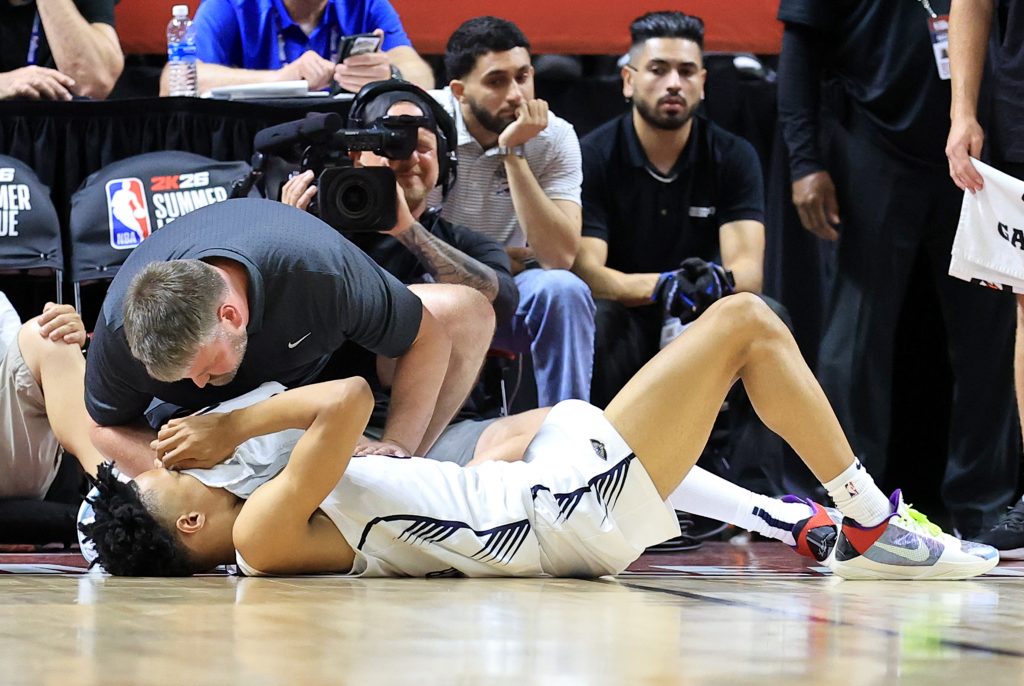
The Utah Jazz guard, Trey Alexander, was taken off the court on a stretcher after sustaining a serious-looking injury during the team’s NBA Summer League game against the Chicago Bulls. The incident occurred when Alexander collided with Bulls rookie Caleb Wilson while driving toward the basket.
Following the contact, Alexander immediately doubled over, clutching the left side of his torso before falling to the floor in visible pain. Medical personnel quickly attended to him, and after several minutes, he was immobilized and transported off the court on a stretcher. He did not return to the game. Neither the Jazz nor the Summer League officials immediately disclosed the nature or severity of the injury.
The Aftermath of Alexander’s Abrupt Exit
As of the latest updates, the Jazz have not announced a formal diagnosis, and it remains unclear exactly which structure was injured during the collision. A video of the play showed Alexander taking contact to the left side of his torso before immediately grabbing the area and collapsing in pain. The fact that he required a stretcher and was unable to leave the floor under his own power prompted medical staff to stabilize him before transport. Such precautions are common in sports medicine when an athlete experiences severe pain or when the extent of an injury cannot be determined immediately.
Without imaging studies or an official medical update, it is not possible to determine the specific injury. Further evaluation, which may include physical examination and diagnostic imaging such as X-rays, ultrasound, or computed tomography (CT) scans, would typically be used to identify injuries involving the ribs, abdominal organs, muscles, or other structures in the torso.
The Possible Reasons That Led to the Immediate Medical Attention
As of now, there is no confirmed Alexander’s diagnosis, and any discussion of the injury must remain general. What is known about the injury is that it was a direct impact to the left side of the torso, which can affect several organs or bones.
According to Medical News Today, possible injuries following this type of impact include:
- Rib contusions or fractures: A forceful blow can bruise or break one or more ribs, causing immediate pain that often worsens with movement, deep breathing, coughing, or twisting.
- Intercostal muscle strain: The muscles between the ribs can be stretched or torn during a collision, resulting in localized pain and difficulty moving the torso.
- Abdominal wall injury: Muscles and soft tissues of the abdominal wall can sustain bruising or tears after blunt trauma.
- Injury to internal organs: The spleen, which sits on the upper left side of the abdomen, is particularly vulnerable to blunt abdominal trauma. Although uncommon, splenic injuries require prompt medical assessment because they can cause internal bleeding. Other abdominal organs may also be evaluated depending on the mechanism of injury and symptoms.
A sudden impact to the torso can trigger intense pain, causing an athlete to instinctively bend forward or clutch the affected area, as Alexander did following the collision. Severe pain may also make standing or walking difficult until the injury is evaluated.
Winning Big Always Comes with Its Risks
Trey Alexander’s injury puts the physical demands of basketball on full display, where high-speed collisions, falls, and contact around the basket can sometimes result in significant injuries despite protective rules and immediate medical care.
Not every collision leads to a serious injury, but impacts involving the chest or abdomen warrant careful evaluation as they may affect bones, muscles, or internal organs. Prompt assessment by athletic trainers and physicians helps determine whether emergency treatment or additional imaging is needed before an athlete can safely return to play.
Contact injuries cannot be completely prevented; several measures can help reduce the risk. Maintaining core strength, using proper body positioning during contact, improving overall conditioning, and following safe playing techniques may lower the likelihood of some musculoskeletal injuries. Equally important is ensuring that athletes receive immediate medical attention when they experience severe pain after a collision, rather than attempting to continue playing.