

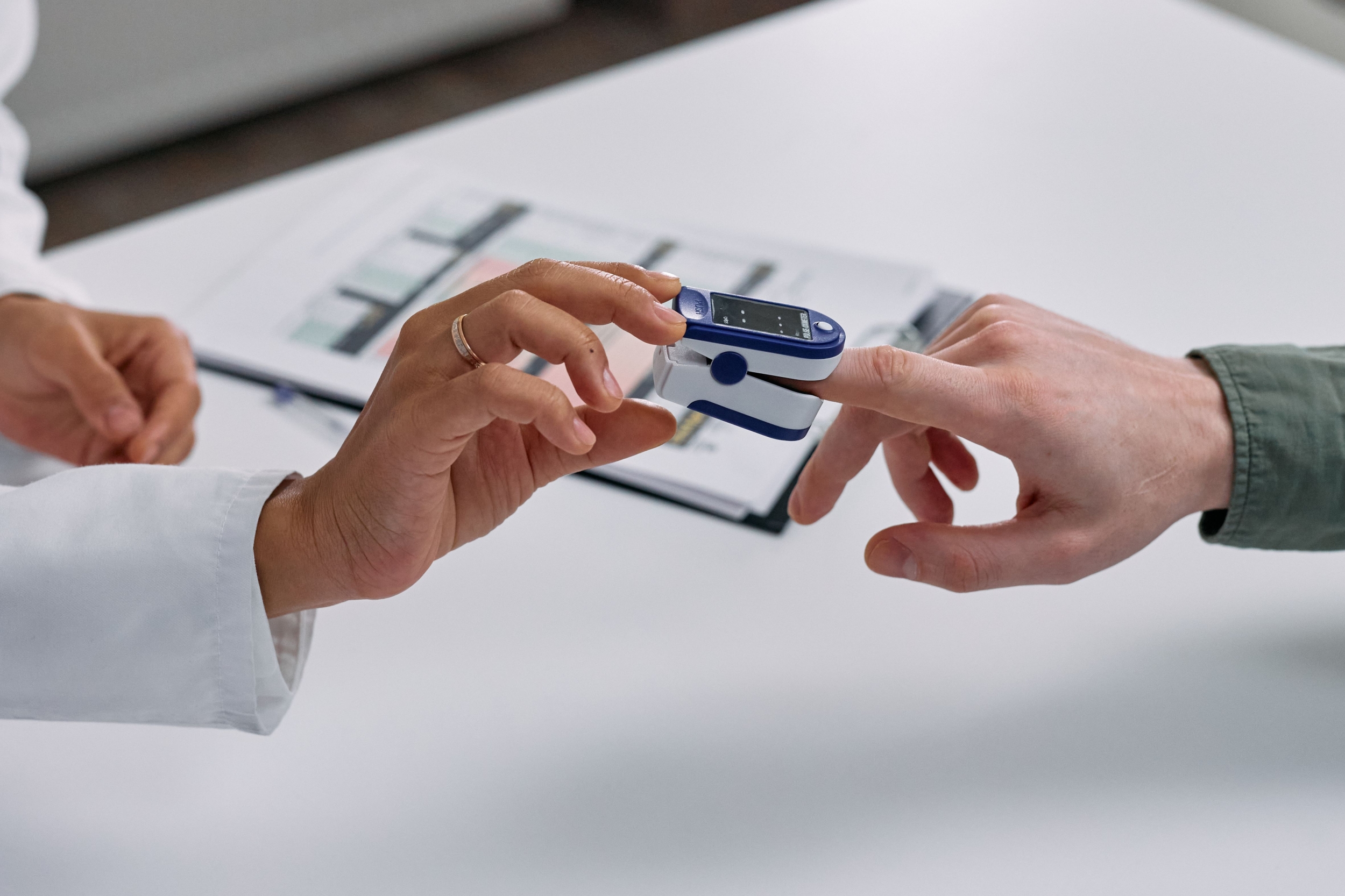
The numbers on the fingertip monitor made no sense. Over a matter of seconds, the pulse oximeter clipped to an adult woman’s finger bounced among readings of roughly 40, 50, and more than 100 beats per minute. The woman felt fine, and her heart turned out to be beating normally. The likely cause was a coat of white nail polish.
The case is described in a report published in January 2026 in the journal Cureus by Akhtar Purvez, of Lincoln Memorial University DeBusk College of Osteopathic Medicine in Harrogate, Tennessee. The case report on erratic oximeter pulse readings involves just one patient, but it points to something most people never consider when they slip a pulse oximeter onto a finger: the heart rate on the screen is calculated from light, not read directly from the heart.
That matters because fingertip oximeters became common in homes during the COVID-19 pandemic, and they remain routine equipment in clinics, emergency rooms, and hospital wards.
A Racing, Then Plodding Pulse That Wasn’t Real
The woman was seen for a routine clinical evaluation. She was stable and had no symptoms, denying dizziness, palpitations, chest pain, or shortness of breath. She had no known medical conditions and took no medications that would affect blood flow to her hands and feet.
Her oxygen saturation reading was normal and steady. The pulse rate was another story. It jumped among values that, if real, would suggest an abnormally slow heart one moment and an abnormally fast one the next. A heart rate that lurches like that can raise concern about a rhythm problem.
So the care team checked the heart directly. A standard 12-lead electrocardiogram (ECG), which records the heart’s electrical activity, showed normal sinus rhythm at a stable rate with no conduction abnormalities. Clinicians removed the white polish from the monitored finger, and the oximeter’s pulse readings settled down and matched the heart rate on the ECG. The author concluded that the wild numbers reflected a problem with the device’s signal, not an arrhythmia.
How Light Can Fake a Heart Rhythm
A pulse oximeter shines red and infrared light through the fingertip. Oxygen-rich and oxygen-poor hemoglobin absorb those wavelengths differently, a principle outlined in the National Library of Medicine’s StatPearls review of pulse oximetry. Each heartbeat pushes a small surge of blood through the finger, and the device tracks those tiny changes as a waveform.
According to the report, the device uses that waveform in two different ways. Oxygen saturation is averaged over time, which smooths out brief glitches. Pulse rate, by contrast, depends on correctly detecting the individual peaks in the waveform.
The author proposed that the white polish may have disrupted the waveform enough to throw off that peak detection without significantly changing the averaged oxygen reading. White pigments tend to reflect the wavelengths oximeters use rather than absorb them, the report notes, which is why white or clear polish is generally considered acceptable for oxygen monitoring.
The proposed mechanism is a hypothesis. The report did not test it directly, and it did not identify the make or model of the standard fingertip pulse oximeter involved.
The report’s central warning is blunt. It states that “pulse oximetry does not assess cardiac electrical rhythm” and should not be used to diagnose arrhythmias. It also stresses that an accurate oxygen reading does not guarantee an accurate pulse reading. Before attributing a sudden, erratic pulse reading to a true rhythm problem, the author recommends confirming the heart rate by feeling the pulse or with an ECG.
Nail Polish Has Long Been on the FDA’s Radar
Nail polish is not a new suspect. In February 2021, the U.S. Food and Drug Administration warned about the limitations of pulse oximeters. The agency listed fingernail polish alongside poor circulation, skin pigmentation, skin thickness, skin temperature, and current tobacco use as factors that can affect readings.
The FDA’s pulse oximeter information page repeats that list. In January 2025, the agency also proposed updated testing recommendations for pulse oximeters, aimed at improving how well the devices perform across skin tones.
Most research on nail polish, however, has focused on oxygen readings, not pulse rate. A systematic review in the journal Emergencias, published in 2015, examined 12 studies. In all but two, at least one polish color produced a statistically significant drop in oxygen readings. The differences were small, though, falling within the devices’ roughly 2% margin of error, and the reviewers judged them not clinically significant.
Dark shades usually get the attention. MedlinePlus notes that dark nail polish can block the light from the oximeter and that artificial nails can also cause inaccurate results. The new report stands out because it involves white polish, and because the oxygen number stayed normal while the pulse number went haywire.
One Patient, but a Useful Reminder
This is a single case report, so it cannot show how often white polish distorts pulse readings or whether some devices are more vulnerable than others. The report did not give exact oxygen values, did not identify the oximeter, and did not describe testing other fingers or polish colors.
Still, the practical lesson is clear. A strange pulse number on a fingertip monitor is not, by itself, proof of a heart rhythm problem. To improve the signal, the author suggests steps such as reducing movement, shielding the sensor from room light, repositioning it, or using a different site. When precise oxygen readings matter most, such as in patients with low oxygen levels or poor circulation, the report recommends removing nail polish, especially dark colors.
For people who use oximeters at home, the takeaway is not to panic over an odd reading. Anyone with symptoms such as chest pain, fainting, a pounding heart, or trouble breathing should seek medical care. People with ongoing concerns about their heart rate should talk with a clinician, who can check what the heart is actually doing with an ECG.
Key Questions Answered
What happened in this case?
An adult woman with no symptoms had a fingertip pulse oximeter reading that bounced among roughly 40, 50, and more than 100 beats per minute. An ECG showed a normal heart rhythm, and the oximeter’s pulse readings stabilized after white nail polish was removed from the monitored finger.
Can a pulse oximeter detect an irregular heartbeat?
No. A pulse oximeter estimates pulse rate from light passing through the finger and does not measure the heart’s electrical activity. The case report states it should not be used to diagnose arrhythmias, which are diagnosed with tests such as an ECG.
Did the nail polish affect her oxygen reading too?
According to the report, her oxygen saturation stayed in the normal range without notable variability. Only the pulse rate reading was erratic.
Is white nail polish known to cause false pulse oximeter readings?
This is one documented case, so it is not known how common the effect is. White or clear polish is generally considered acceptable for oxygen monitoring, and earlier research on polish, especially darker colors, found only small effects on oxygen readings.
What does the FDA say about nail polish and pulse oximeters?
The FDA lists fingernail polish among several factors that can affect pulse oximeter accuracy, along with poor circulation, skin pigmentation, skin thickness, skin temperature, and current tobacco use.
What should someone do if a home oximeter shows a strange heart rate?
A single odd reading may reflect a problem with the signal rather than the heart. People with symptoms such as chest pain, fainting, or shortness of breath should seek medical attention, and those with ongoing concerns should talk with a clinician.
Published by Medicaldaily.com


